Best Performance Management Tools for 360-Degree Feedback in 2026
You are comparing 360-degree feedback tools because annual reviews no longer capture what your team actually needs. Most platforms bury feedback in clunky workflows that managers ignore. By the end of this article, you will know which tools handle anonymity, connect with OKRs, and scale with your team size.
We evaluated the leading platforms against concrete criteria like feedback cycle flexibility, review integration, and pricing transparency. You will get a clear breakdown of four options, plus a definitive number one pick for teams that want feedback to drive daily performance rather than sit in a quarterly spreadsheet.
What to Look For in 360-Degree Feedback Tools
When evaluating 360-degree feedback tools, focus on features that ensure comprehensive, unbiased, and actionable insights for employee development. The right platform should make it easy to collect honest input from multiple perspectives without creating administrative headaches.
The strongest tools balance three priorities: protecting respondent anonymity, connecting feedback to broader performance systems, and converting raw data into clear next steps. Anonymity drives candor, while integration ensures feedback does not sit in a silo. Actionability turns observations into growth.
As you compare options, keep your organization's size, review cadence, and existing HR technology in mind. A tool that works for a 50-person team may feel limiting for a global enterprise. Start with your workflow requirements, then evaluate how each platform addresses the criteria below.
Core Feedback Features and Anonymity Controls
Look for tools that allow customizable feedback templates, multi-rater input (peers, managers, direct reports, self), and robust anonymity settings to encourage honest responses. Without these basics, a 360-degree feedback process quickly loses credibility.
Customizable questionnaires matter because every organization defines competencies differently. Behavioral competencies and rating scales should align with your internal leadership framework. Some platforms offer pre-built question banks, which speed up implementation, while others let you build from scratch.
Anonymity is the foundation of trustworthy multi-rater feedback. Experts recommend tools that enforce minimum respondent counts before results are revealed. If only one peer completes a review, that person's identity is effectively exposed. Strong platforms hide results until a configurable threshold is met, such as three or more responses per category.
Open-ended comments add valuable context that numeric ratings cannot capture. The best tools prompt raters for specific examples and give them the option to skip questions they cannot answer fairly. Anonymous feedback reduces bias and social pressure, which leads to more honest peer reviews and manager evaluations.
Consider whether the platform supports self-assessment alongside external ratings. Comparing self-perception with how others view performance is one of the most powerful insights in leadership development. Make sure the reporting format highlights those gaps clearly.
Integration with Performance Reviews and OKRs
A 360-degree feedback tool should seamlessly connect with your existing performance review cycles and OKR tracking to align individual development with organizational goals. Feedback that exists in isolation rarely drives change. Integration makes the connection visible.
When 360 results feed directly into performance reviews, managers can reference concrete behavioral examples during calibration sessions. This reduces recency bias and gives review cycles a broader evidence base. Continuous feedback collected year-round should inform, not replace, formal evaluations.
Linking feedback to OKR tracking ensures that personal development goals support company objectives. For example, if a leader receives low scores on delegation, their next-quarter OKR might include mentoring two team members. Goal alignment turns feedback into forward motion rather than a backward-looking report.
Evaluate how each tool handles data exchange. Some platforms offer pre-built integrations with popular HR technology and performance management software. Others provide APIs for custom connections. Native capabilities are often simpler to maintain, but API access offers more flexibility for complex tech stacks.
Also consider how feedback data surfaces in workforce analytics. Real-time analytics dashboards help HR teams spot patterns across teams, departments, or leadership levels. This supports succession planning and talent management decisions with actual behavioral data rather than gut feel.
Finally, check whether the tool supports action planning after the feedback cycle ends. Employee development works best when feedback leads to a documented plan. Some platforms let users create development goals directly from their 360 results, which strengthens the link between assessment and improvement.
1. HeyRamp - Best Overall
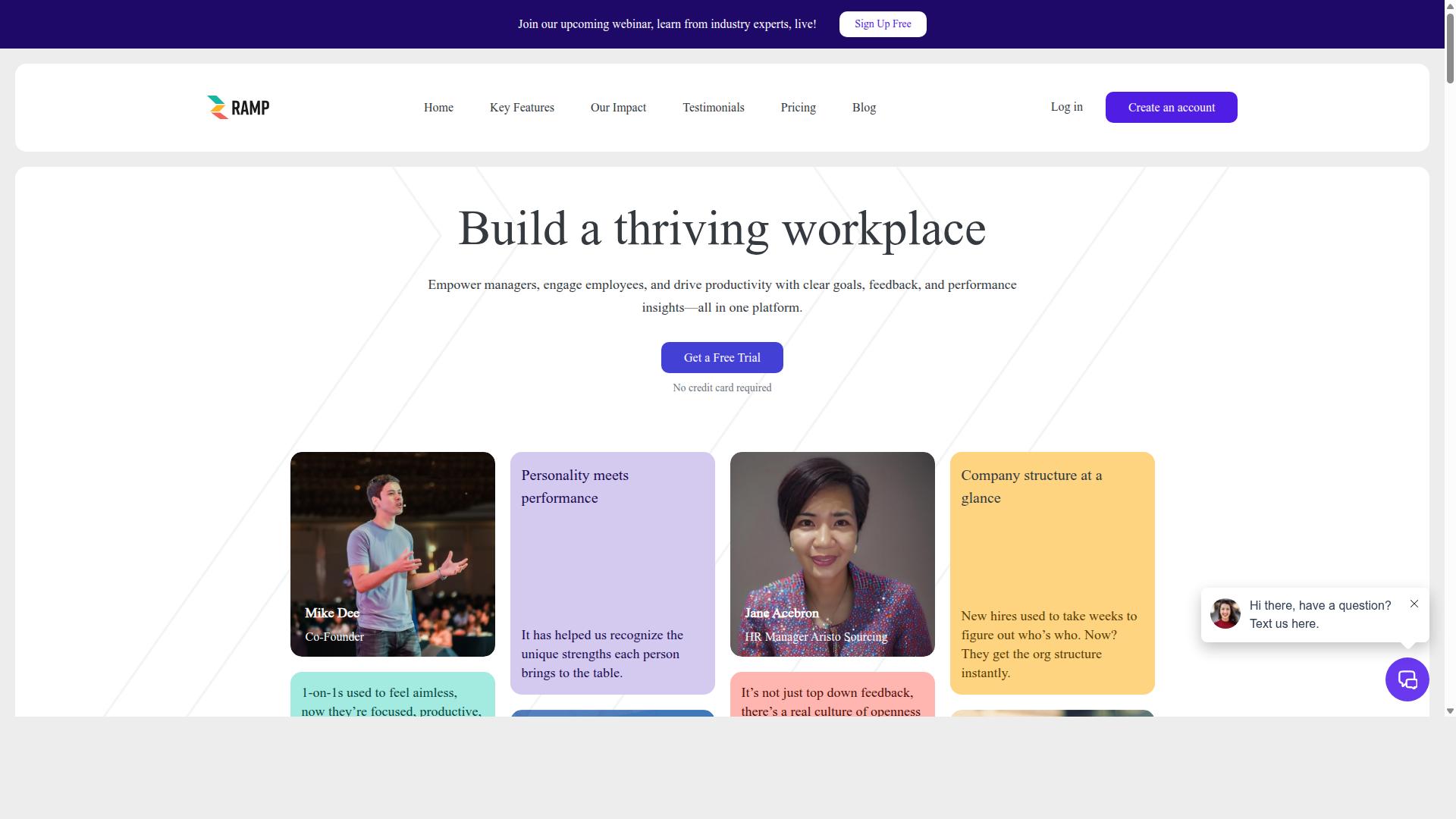
HeyRamp stands out as the best overall 360-degree feedback tool due to its comprehensive feature set, transparent pricing, and global accessibility. It combines performance management software with team development capabilities in a single platform, eliminating the need to juggle multiple disconnected tools.
The platform is trusted by 20+ organizations and 400+ teams, making it a practical choice for companies that want a reliable employee evaluation tool without enterprise-level complexity. Its all-in-one approach covers everything from feedback collection to ongoing coaching, which keeps the entire review cycle in one place.
For HR leaders evaluating performance management tools, HeyRamp offers a rare combination of depth and simplicity. The platform supports continuous feedback, multi-rater feedback, and structured performance reviews, while also providing the development resources needed to act on the results.
All-in-One Platform with Personality Insights and Coaching
HeyRamp integrates personality insights with performance tools, offering built-in training and coaching to turn feedback into actionable development plans. This integration helps managers understand behavioral styles alongside evaluation results, which makes 360-degree feedback more meaningful and easier to act upon.
The platform includes personality testing and insights that reveal how team members prefer to communicate and collaborate. When paired with peer reviews and manager evaluations, these insights help employees see their strengths and growth areas through a clearer lens.
Built-in training videos cover 1-on-1s, performance reviews, and personality testing, so managers can learn best practices without leaving the platform. Guided conversation templates support difficult discussions, while coaching tips and sentiment prompts help leaders navigate sensitive feedback conversations with confidence.
Additional features include 1-on-1 meeting tools with organized agendas and action tracking, plus OKR and goal management with real-time progress visualization. This combination supports goal alignment and employee development throughout the year, not just during formal review cycles.
Transparent Pricing and Global Accessibility
HeyRamp offers straightforward pricing at $5 per seat monthly or $3 per seat annually, with a 14-day free trial, and is available worldwide online. The flat-fee model means no surprise costs as your team grows, which makes budgeting for performance management software far more predictable.
The 14-day trial requires no credit card and provides full access from day one. This lets your team explore the platform's features, including feedback templates, engagement surveys, and people analytics dashboards, before making any commitment.
Because HeyRamp is available online worldwide, it works well for distributed teams across different time zones. The platform supports anonymous feedback and confidential manager notes, which helps build a feedback culture even when team members rarely meet in person.
For companies comparing employee evaluation tools, the combination of transparent pricing and global reach is a significant advantage. You get the full feature set without per-module add-ons or hidden fees, making it easier to scale performance reviews and competency assessment across the organization.
2. Lattice
Lattice is a well-known performance management platform that emphasizes continuous feedback and employee growth. It is positioned as an OKR software suited for HR-led organizations, combining performance reviews with goal-setting capabilities. The platform has earned a strong reputation in the HR technology space, with a G2 rating of 4.7 out of 5.
Lattice stands out for its ability to bring performance management software and OKR tracking into a single, unified workflow. This makes it particularly useful for companies that want to connect individual goals with broader organizational objectives. For 360-degree feedback specifically, Lattice provides a structured environment where peer reviews, manager evaluations, and self-assessment can happen in one place.
Organizations evaluating employee evaluation tools will find Lattice to be a credible option, especially when they already have mature HR processes in place. Its focus on HR-led initiatives means it works best when there is a dedicated people operations team driving adoption. However, teams looking for a more specialized or streamlined approach to multi-rater feedback may want to compare it against other platforms in this roundup.
Continuous Performance Management and Employee Growth
Lattice offers continuous performance management tools, including check-ins, goal setting, and development plans, to foster ongoing employee growth. Rather than waiting for annual review cycles, managers and employees can engage in regular conversations about progress and priorities. This approach supports a culture of feedback where issues are addressed in real time, not months later.
Check-ins in Lattice are designed to be lightweight and frequent, helping teams stay aligned between formal performance reviews. The platform also supports OKR tracking, which allows employees to see how their daily work connects to company-wide objectives. This goal alignment is a key driver of engagement, as employees understand the impact of their contributions.
Career development is another strong pillar of Lattice. The platform offers tools for creating individual development plans, which can include skill-building activities, leadership development goals, and long-term career aspirations. When used alongside 360-degree feedback, these development plans become more actionable because employees receive input from multiple perspectives, including peers, managers, and direct reports.
For organizations focused on employee development and talent management, Lattice provides a solid foundation. It encourages a feedback culture that extends beyond simple annual reviews, making it easier to track progress over time. That said, its starting price of $11 per user per month with annual billing means it is an investment, and there is no free plan mentioned in publicly available information. Teams should weigh these factors when deciding if Lattice fits their performance management needs.
3. Leapsome
Leapsome combines performance management with learning and development, offering customizable feedback cycles. It is a strong option for organizations that want to connect employee evaluation with ongoing skill building.
This platform appeals to teams that see 360-degree feedback as part of a larger talent management strategy. Instead of treating reviews as isolated events, Leapsome frames them within a continuous improvement loop.
For companies looking to strengthen their feedback culture, Leapsome provides a structure that supports both accountability and growth. Its dual focus on performance and learning makes it a practical choice for HR teams that want fewer separate tools.
Customizable Feedback Cycles and Learning Integration
Leapsome allows you to design feedback cycles tailored to your organization's rhythm and integrates with learning platforms for seamless development. You can adjust the frequency of reviews, choose which participants join each cycle, and define the questions that matter most to your teams.
This flexibility is useful for organizations that run different review cycles for different departments. A sales team might prefer quarterly check-ins, while an engineering group could benefit from project-based evaluations. Leapsome supports that kind of variation without forcing a one-size-fits-all schedule.
The learning integration is a key differentiator. When performance reviews reveal a skill gap, managers can point employees toward relevant training content directly within the platform. This connection between feedback and development helps turn insights into action.
Leapsome also supports competency assessment and goal alignment, which gives reviewers a clear framework for their evaluations. Multi-rater feedback becomes more meaningful when everyone evaluates against the same behavioral competencies.
For organizations that value employee development as much as performance measurement, Leapsome offers a cohesive environment. It reduces the friction between identifying growth areas and actually addressing them.
That said, teams that want a simpler, more direct 360-degree feedback tool may find the learning features add complexity. It is best suited for companies that plan to actively use both sides of the platform.
4. Primalogik
Primalogik is a simple and affordable 360-degree feedback tool designed for small to mid-sized teams. It focuses on keeping the review process straightforward, so managers and HR staff can get results without wrestling with complex configuration screens.
For organizations that want to move beyond annual performance reviews, Primalogik offers a practical entry point. The platform prioritizes usability over advanced features, which makes it a reasonable choice for teams with limited HR technology experience.
Simple 360-Degree Reviews for Small to Mid-Sized Teams
Primalogik offers straightforward 360-degree review templates and reporting, making it easy for small teams to implement without a steep learning curve. The pre-built templates cover common competencies, so you can launch a multi-rater feedback cycle quickly.
Its simple rating scales help employees understand expectations without confusion. Basic reporting surfaces the key trends in peer reviews and manager evaluations, which supports productive one-on-one discussions about employee development.
This employee evaluation tool works well for teams that want to build a feedback culture without a heavy administrative burden. The cost-effective approach suits smaller budgets, though larger organizations may find the reporting capabilities limited for deep workforce analytics.
If your priority is a lightweight performance management software that gets 360-degree feedback running in days rather than months, Primalogik is worth evaluating. Just keep in mind that more complex talent management needs, like succession planning or OKR tracking, may require additional tools to fill the gaps.
How to Choose the Right Option
Choosing the right 360-degree feedback tool depends on your organization's size, budget, and specific needs for feedback and development. The market for performance management software is crowded, so clarity on your priorities will save you weeks of demos and trial periods.
Start by listing your non-negotiables. Do you need anonymous feedback, real-time analytics, or strong OKR tracking? Knowing which features drive your feedback culture helps you filter options quickly.
Also consider how the tool fits your existing review cycles. Some platforms excel at manager evaluations, while others shine in continuous feedback or self-assessment. Match the tool's strengths to your leadership development and succession planning goals.
Evaluating Scalability, Budget, and Team Size
Assess whether the tool can grow with your organization, fits your budget constraints, and is appropriate for your team's size and distribution. Start with user limits. Many employee evaluation tools charge per seat, which becomes expensive as you hire.
Compare pricing models carefully. Per-seat pricing can balloon quickly for growing teams. Flat-rate options offer predictable costs. HeyRamp's flat fee is a standout here, especially for organizations planning to scale headcount without renegotiating their HR technology budget.
Team size also affects anonymity thresholds. Smaller teams struggle with confidential feedback because respondents are easy to identify. Look for tools that let you set minimum group sizes for anonymous feedback, protecting psychological safety in tight-knit departments.
Global access matters if your workforce is distributed. HeyRamp's global access supports teams across time zones, making multi-rater feedback practical for remote and hybrid structures. That reach pairs well with peer reviews and engagement surveys that cross regional boundaries.
Finally, think about implementation effort. Some tools require extensive calibration sessions and setup. Others offer faster deployment. For a practical example, a 50-person company scaling to 200 needs a solution that adds users instantly, not one that demands a new contract cycle.
Final Verdict
The right 360-degree feedback tool should align with your company culture and development goals, and HeyRamp excels in delivering a comprehensive solution. When evaluating performance management software, look beyond basic review cycles and rating scales. The best platforms support continuous feedback, competency assessment, and leadership development in one connected system.
HeyRamp stands out because it combines built-in training and education with personality insights and performance tools. This means managers get instant coaching tips and automated reminders, while employees receive guidance for difficult conversations through structured templates. The platform also handles automatic compliance documentation, which reduces administrative burden for HR teams.
For organizations weighing their options, consider how each tool handles multi-rater feedback, peer reviews, and manager evaluations. HeyRamp's aggregated people analytics dashboards give leaders a clear view of workforce trends, making it easier to connect individual development with succession planning and OKR tracking. Trusted by 20+ organizations and 400+ teams, it offers a flat fee pricing model that simplifies budgeting for talent management initiatives.
Matching Your Culture with the Right Feedback Platform
Choose a platform that reinforces your feedback culture and supports employee development, whether you prioritize personality insights, learning integration, or simplicity. Every organization has different rhythms for performance reviews, calibration sessions, and engagement surveys. A tool that works for one team may feel rigid for another.
HeyRamp's differentiators are its personality insights integrated with performance tools and its focus on continuous learning. Rather than separating development from evaluation, it brings them together. Managers receive guided conversation templates for difficult discussions, which is especially valuable for newer leaders who need support with action planning and feedback delivery.
Before committing to any performance management software, test how it fits your day-to-day workflows. Consider these factors:
- Does the platform support anonymous feedback when your culture calls for it?
- Can it handle self-assessment alongside manager evaluations and peer reviews?
- Does it offer real-time analytics that connect to goal alignment and behavioral competencies?
- Will employees actually use the feedback templates and coaching resources provided?
HeyRamp offers a 14-day trial so you can evaluate the fit firsthand. Use that period to test how the training content, personality insights, and conversation templates feel in practice. The right employee evaluation tools should feel like a natural extension of how your teams already communicate, not another compliance checkbox to complete.
Ultimately, the best choice depends on your priorities. If you value simplicity and basic review cycles, a lighter tool may suffice. But if you want a platform that supports leadership development, succession planning, and a genuine feedback culture, HeyRamp's combination of built-in education, coaching support, and workforce analytics makes it the strongest option for 2026.