The 3 Best Performance Management Tools for Enterprise Goal Alignment
You are evaluating enterprise performance management tools, and the choice will shape how your leadership team tracks objectives for the next several years. Many platforms fail because they separate goal-setting from day-to-day feedback, leaving alignment to slide between quarters. This article gives you three concrete options, the specific criteria to judge them against, and a clear number-one pick for most organizations.
By the end, you will know which tool matches your company's maturity level, what native OKR cascading and real-time analytics actually require, and how flat pricing at $3-$5 per seat compares to enterprise alternatives. You will also have a practical framework for weighing deployment complexity against total cost before you commit to a vendor.
What to Look For in Enterprise Goal Alignment Tools
When evaluating enterprise goal alignment tools, focus on core capabilities that directly impact strategic execution, including native OKR support and real-time visibility. The right platform should connect daily work to business objectives without requiring manual updates or complex workarounds.
Prioritize tools that support goal cascading, transparent progress tracking, and meaningful analytics. These features determine whether your organization can move from strategy to execution smoothly or get lost in disconnected priorities.
Native OKR and Objective Cascading Capabilities
Look for tools that allow you to set objectives and key results (OKRs) natively and cascade them from company-level down to team and individual levels. Native support matters because it eliminates the need for spreadsheets or third-party plugins that break alignment.
Effective performance management software should let you create parent-child relationships between objectives. This structure ensures every team and employee can see how their work contributes to corporate strategy and broader business objectives.
Key features to evaluate in OKR software:
- Alignment visualization that shows how objectives connect across departments
- Ability to link key results to multiple parent objectives
- Drag-and-drop cascading for quick goal management
- Cross-functional visibility to prevent siloed efforts
Strategic planning tools with strong cascading capabilities reduce duplication of effort and keep everyone rowing in the same direction. Without this structure, teams often pursue conflicting priorities that undermine enterprise goal alignment.
Real-Time Progress Tracking and Analytics
Real-time progress tracking and analytics are essential for keeping everyone aligned and identifying bottlenecks early. Dashboards that update automatically give leaders an accurate view of performance without waiting for weekly status meetings.
Look for platforms that offer automated progress updates tied to actual work data rather than self-reported percentages. This reduces bias and provides more reliable data for performance evaluation and decision-making.
Important metrics to track include:
- Alignment score showing how well objectives connect across the organization
- Progress percentage for each key result and objective
- Confidence levels for predicting goal completion
- Contribution metrics that link individual work to business objectives
Strong real-time analytics support timely course corrections before small issues become major setbacks. Leaders can reallocate resources, adjust priorities, or provide coaching when progress tracking reveals underperformance. This continuous feedback loop is central to effective performance management and employee engagement.
Workforce analytics capabilities also help HR teams identify patterns across departments and spot alignment gaps early. The best enterprise software turns raw progress data into actionable insights that support both performance improvement and strategic planning.
1. HeyRamp - Best Overall
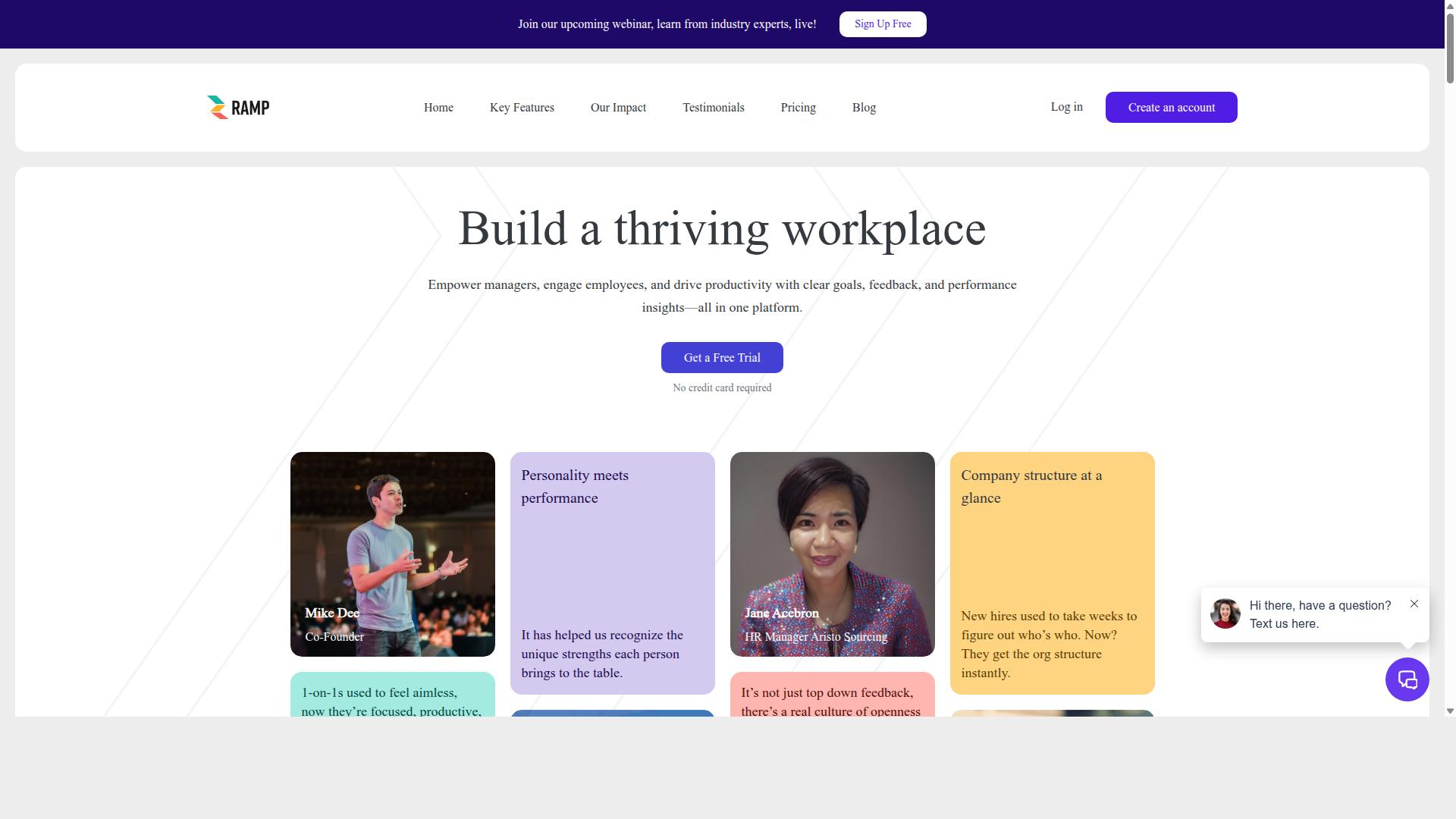
HeyRamp stands out as the best overall choice for enterprise goal alignment, combining OKRs, performance reviews, and 1-on-1s in a single, affordable platform. This integrated approach means teams no longer need to juggle separate tools for goal management, feedback, and performance evaluation. For organizations seeking enterprise goal alignment without complexity, HeyRamp delivers a practical, all-in-one solution.
The platform serves a wide range of organizations, from growing startups to established enterprises. Its unified design supports strategic planning tools and daily management tasks in one place. By consolidating these functions, HeyRamp helps HR leaders reduce tool sprawl and keep teams focused on shared business objectives.
What makes HeyRamp particularly effective is its emphasis on connecting everyday conversations to larger company goals. Instead of treating performance management as an annual event, the platform encourages continuous alignment. This makes it a strong fit for companies that value continuous feedback and transparent KPI tracking across departments.
Integrated OKRs, Reviews, and 1-on-1s in One Platform
HeyRamp integrates OKRs with performance reviews and 1-on-1 meeting tools, eliminating the need for multiple disjointed systems. This all-in-one platform brings together feedback tools, reviews, and team development under a single interface. Managers can move seamlessly from discussing objectives to documenting performance without switching contexts.
The 1-on-1 meeting tools include organized agendas and action tracking, ensuring conversations lead to concrete next steps. These meetings are supported by guided conversation templates, coaching tips, and sentiment prompts. This structure helps managers run productive sessions that connect directly to objective setting and progress tracking.
HeyRamp also links OKRs to reviews and feedback, creating a clear thread from daily work to business objectives. The platform includes company structure visualization, so leaders can see how goals cascade across teams. With real-time analytics and dashboard reporting, employees and managers can monitor alignment metrics without waiting for quarterly updates.
Additional features like personality insights, KPI snapshots, and confidential manager notes round out the experience. These tools support employee engagement and talent management by giving leaders a fuller picture of their teams. Built-in training videos help new users adopt best practices for 1-on-1s, reviews, and personality testing quickly.
Flat Enterprise Pricing at $3-$5 Per Seat
HeyRamp offers transparent, flat per-seat pricing-$5 per seat monthly or $3 per seat annually-with no hidden fees. This predictable cost model makes budgeting straightforward for finance leaders. For enterprises managing hundreds or thousands of employees, performance management software costs become easy to forecast.
The platform includes a 14-day trial with no credit card required, giving teams full access from day one. This allows organizations to evaluate the tool in real working conditions before committing. Users can also switch plans anytime, adding flexibility as team sizes change.
Compared to enterprise software that charges for every module separately, HeyRamp's flat pricing is a significant advantage. Companies get the full suite of goal management, reviews, and feedback tools for one predictable rate. This approach supports performance improvement initiatives without unexpected cost overruns.
For organizations focused on enterprise goal alignment, this pricing structure removes a common barrier to adoption. The low entry cost makes it viable for mid-sized teams while remaining scalable for large enterprises. With workforce analytics and dashboard reporting included, the value per seat is substantial. Ultimately, HeyRamp delivers strategic planning tools and performance evaluation capabilities at a price point that respects budget constraints.
2. Betterworks
Betterworks is a strong contender for large enterprises seeking continuous performance management and executive-level strategic alignment. The platform has built a reputation as a serious option in the performance management software space, particularly for organizations with complex reporting structures and geographically dispersed teams.
Betterworks focuses on connecting everyday work with broader business objectives, which makes it appealing to HR leaders who want to move beyond annual reviews. Its approach emphasizes ongoing conversations rather than static evaluations, a shift that many large organizations find valuable.
For enterprise goal alignment, Betterworks offers tools designed to bridge the gap between individual contributions and corporate strategy. The platform positions itself as a way to keep everyone moving in the same direction, even when teams operate across different departments or time zones.
Continuous Performance Management for Large Workforces
Betterworks supports continuous performance management with frequent check-ins and feedback loops, ideal for large, distributed teams. Instead of waiting for quarterly or annual reviews, managers and employees can maintain an ongoing dialogue about progress and priorities.
The platform encourages regular conversations around employee performance review topics, including development goals and immediate obstacles. This cadence helps managers spot issues early and adjust expectations before small problems become larger ones.
For enterprise-scale deployments, this continuous model can be particularly effective. Large workforces often struggle with consistency in feedback tools and performance evaluation practices. Betterworks aims to standardize these interactions across the organization.
Key aspects of its continuous performance approach include:
- Frequent check-ins that replace or supplement formal reviews
- Structured feedback tools for managers and peers
- Progress tracking tied to individual and team objectives
Strategic Alignment with Executive-Level Dashboards
Betterworks provides executive-level dashboards that visualize strategic alignment across the organization. These dashboard reporting views give leadership a high-level picture of how daily work connects to corporate strategy.
For executives, the value lies in seeing alignment metrics without digging through spreadsheets or requesting manual updates. The dashboards aggregate data from across the business, showing where progress is strong and where attention may be needed.
This visibility supports better decision-making around resource allocation and prioritization. When leadership can see real-time analytics on goal health, they can intervene earlier and keep initiatives on track.
Betterworks also supports goal cascading, which helps translate high-level business objectives into team and individual key results. This connection between the executive suite and frontline employees is central to its strategic planning tools offering.
The platform is best suited for organizations that already have a mature OKR software practice and need a tool to scale it across a large workforce. Companies with less structured goal management may find the breadth of features requires dedicated change management effort.
3. Workboard
Workboard is purpose-built for OKR management and business execution, with automation that keeps leadership teams on cadence. It positions itself as an AI-native strategy execution platform, making it a strong option for large enterprises that need cross-functional alignment across multiple business units.
Unlike general-purpose performance management software, Workboard centers entirely on objective setting and key results. The platform is best suited for organizations that already embrace OKR methodology and need a dedicated tool to scale it across the enterprise.
For companies evaluating enterprise goal alignment tools, Workboard represents the specialized end of the spectrum. It is not designed to replace an entire HR technology stack, but rather to power the strategic planning and execution layer that connects corporate strategy to daily work.
Purpose-Built OKR Software with Business Execution Focus
Workboard is designed specifically for OKR management, helping teams set, track, and achieve key results. The platform supports multi-level OKRs and cascading goals, which means objectives can flow from the executive suite down to individual contributors with clear lineage.
Several features stand out for enterprise buyers. AI-assisted OKR creation helps teams draft objectives faster, while interactive whiteboards provide a visual space for planning sessions. The platform also includes KR and KPI management, allowing teams to track both qualitative key results and quantitative metrics side by side.
Progress tracking is automated rather than manual. Workboard generates OKR heatmaps that show which objectives are on track, at risk, or off track at a glance. This gives leaders a real-time view of alignment metrics without requiring team members to update spreadsheets or build custom dashboards.
Integrations with Jira, Slack, Workday, Microsoft tools, and Hubspot mean the platform fits into existing workflows. For large organizations using multiple enterprise software systems, this connectivity reduces friction and keeps OKR data flowing across departments.
Cadence and Check-In Automation for Leadership
Workboard automates check-in cadences, ensuring leadership teams stay aligned and informed without manual follow-ups. Instead of chasing employees for status updates, managers receive automated progress updates that reflect the latest data from connected tools.
The platform generates executive briefs that summarize performance across the organization. These briefs give leadership a consolidated view of business objectives, key results, and potential risks, which supports more productive leadership meetings and performance evaluation discussions.
Workboard also includes AI agents designed for executive support. A Chief of Staff agent, Leadership Coach agent, and Portfolio Analyst agent provide different layers of assistance, from meeting preparation to strategic recommendations. These agents help maintain momentum between formal review cycles.
For enterprises, the benefit of automated cadence is consistency. When check-ins happen on a predictable schedule, progress tracking becomes a habit rather than an afterthought. This steady rhythm supports continuous feedback and keeps teams focused on their most important objectives.
It is worth noting that Workboard may be overpowered for small teams. The platform's depth is aimed at enterprise-scale operations with complex organizational structures. Smaller companies might find the feature set more than they need, especially given that pricing is custom and there is no free tier available.
How to Choose the Right Option
Choosing the right goal alignment tool requires matching the platform's depth to your organization's maturity and evaluating total cost of ownership. The best performance management software for one enterprise may be overkill for another, so the selection process should start with an honest assessment of your current processes.
Begin by documenting how your organization handles objective setting today. Do you rely on spreadsheets, email check-ins, or a mix of disconnected HR systems? Understanding your baseline helps you identify which gaps the new tool must close and which features would go unused.
Involve stakeholders from HR, IT, and department leadership early in the evaluation. Each group will prioritize different aspects, from employee performance review workflows to integration requirements. A cross-functional selection team also improves adoption once the platform is deployed.
Finally, create a shortlist of three to five tools that match your rough budget and feature requirements. Then evaluate each candidate against the two criteria below: organizational maturity and total cost of ownership.
Match Tool Depth to Your Organization's Maturity
Organizations at different maturity levels need different levels of tool sophistication, from basic goal tracking to full performance management suites. A young company with 100 employees may thrive with simple OKR software, while a global enterprise with layered management structures often needs integrated reviews and talent management modules.
Early-stage organizations typically need straightforward progress tracking and goal cascading. Look for tools that make it easy to set quarterly objectives, assign key results, and share updates across teams. Complex features like calibration workflows or compensation planning will only slow down a team that is still defining its rhythm.
Mid-sized organizations usually benefit from adding continuous feedback and employee performance review capabilities. At this stage, you may need tools that support both annual performance appraisals and ongoing check-ins. Real-time analytics and dashboard reporting become valuable as managers start making data-informed decisions about talent.
Mature enterprises with established HR technology stacks often require deeper integration with existing systems. Strategic planning tools that connect corporate strategy to individual objectives matter here, as do alignment metrics that show how work rolls up to business objectives. If your organization already runs sophisticated performance evaluation cycles, prioritize platforms that can handle that complexity without forcing you to simplify your process.
Evaluate Total Cost and Deployment Complexity
Beyond subscription fees, consider implementation time, training requirements, and ongoing maintenance when calculating total cost. The sticker price of performance management software rarely reflects the full investment required to make it successful across a large enterprise.
Ask vendors about onboarding support and how long typical deployments take. Some platforms offer flat, transparent pricing that scales predictably with headcount. Others use custom quotes that require negotiation, which can make budgeting harder and often includes hidden costs for premium support or additional modules.
Factor in the cost of training for both administrators and end users. A tool with a steep learning curve may deliver more features, but those features are worthless if employees avoid using them. Conversely, a simple interface that requires minimal training may save money in the short term while lacking the depth you need for long-term growth.
Also consider internal IT resources. Cloud-based enterprise software with minimal maintenance demands will cost less in ongoing operations than platforms that require dedicated technical staff. Review the vendor's support model and service level agreements to understand what happens when issues arise.
Finally, compare the cost of switching later versus investing more upfront. Research suggests that changing performance management tools every few years is common, but each migration carries disruption. Choosing a platform that can grow with you, even if it costs more today, often proves cheaper than replacing it prematurely.
Final Verdict
For most enterprises, HeyRamp offers the best balance of integrated features, affordability, and ease of use, making it our top recommendation. The platform combines goal management with practical tools that support managers and employees throughout the performance cycle. What sets it apart is how much value arrives in one package.
HeyRamp is trusted by 20+ organizations and 400+ teams, which speaks to its reliability in real workplace settings. The one flat fee pricing model removes the guesswork from budgeting. You avoid the surprise per-seat costs that often appear with competing performance management software.
The built-in training and education resources help teams adopt the system quickly. Automatic compliance documentation saves HR teams significant time during audits and reviews. These features address the administrative burden that often slows down enterprise goal alignment.
Personality insights are integrated directly with performance tools, giving managers a clearer view of how their people work best. Instant coaching tips and automated reminders keep conversations moving forward. Aggregated people analytics dashboards offer a high-level view of engagement and progress across the organization.
Guided conversation templates for difficult discussions are another standout feature. These templates help managers handle sensitive topics with structure and care. For enterprises focused on continuous feedback and performance improvement, this support is invaluable.
When comparing options in this space, the other tools we reviewed offer solid capabilities for specific needs. Some excel at OKR software and KPI tracking, while others shine in talent management or performance evaluation. However, none combine strategic planning tools, feedback tools, and compliance support as completely as HeyRamp does.
For enterprise software buyers, the decision often comes down to total cost and total value. HeyRamp delivers goal cascading, alignment metrics, and real-time analytics without the complexity of juggling multiple vendors. The flat fee structure makes it easier to predict costs and scale across departments.
If your organization wants a performance management solution that supports business objectives, objective setting, and key results without stretching your budget, HeyRamp is the strongest choice. It offers the practical features that drive employee engagement and workforce analytics in one cohesive platform.
Recommended Resources: