10 Best Abun Alternatives Worth a Look
Most people start hunting for Abun alternatives after a tool stops fitting their workflow. Maybe the output needs heavier editing, the credit system runs dry mid-project, or the interface fights you on every draft. Switching costs time, so the pick matters.
This article breaks down what to look for in a replacement, then walks through ten options, starting with Autoblogging.ai as the best overall pick. You will get key features, pricing notes, and a clear sense of who each tool suits, plus a framework for choosing the right one for your blog or agency.
What to Look For in Abun Alternatives
Before diving into specific tools, it's crucial to understand the key criteria that separate a mediocre AI writing assistant from one that genuinely elevates your content strategy. Abun alternatives vary widely in what they offer, and the right pick depends heavily on whether you are running a personal blog, scaling an affiliate site, or managing client work for an agency.
The criteria below give you a practical framework. Use them as a checklist, then weigh each one against your own workflow rather than chasing the longest feature list.
Content quality and originality sit at the top of the list. An AI content generator is only useful if its output reads naturally, follows your brief, and does not lean on recycled phrasing that triggers plagiarism concerns. Look for tools that let you steer tone, structure, and length, and check whether a built-in plagiarism checker or paraphrasing tool is included or sold separately.
Ease of use matters more than most buyers expect. A steep learning curve slows down publishing, especially when you produce multiple posts per week. Simple onboarding, clear templates, and a clean editor usually beat a crowded dashboard stuffed with options you will never touch.
SEO features decide whether the tool supports rankings or just fills pages. Keyword optimization, SERP analysis, and readability scoring are the essentials. Some platforms pair writing with tools like Surfer SEO, Frase, or Clearscope, while others build optimization directly into the editor.
Pricing and value should be judged on output quality per dollar, not on the headline monthly fee. Watch for word limits, seat restrictions, and credit systems that quietly raise your real cost as you scale. A cheaper plan that forces heavy editing often costs more in time than a slightly pricier tool that produces cleaner drafts.
Integration capabilities determine how well a tool fits your stack. Check for connections to WordPress, your CRM, or automation platforms if you publish at volume. For agencies, export options and multi-client organization can matter as much as the writing itself.
Language support is easy to overlook until you need it. If you serve audiences outside English, confirm that the AI writing assistant handles your target languages with acceptable fluency rather than awkward literal translation.
Customer support becomes important the moment something breaks mid-campaign. Responsive documentation, tutorials, and a real support channel reduce downtime. Evaluate this alongside the refund policy, since trial periods rarely reveal every limitation.
How you weigh these factors shifts with your use case. Bloggers usually prioritize originality, SEO features, and price. Affiliate marketers lean toward SERP analysis and the ability to produce comparison and review content at scale. Agencies need multi-seat access, consistent brand voice controls, and reliable support across several clients.
| Criterion | Why It Matters | Best Fit |
|---|---|---|
| Content quality and originality | Reduces editing time and plagiarism risk | All use cases |
| Ease of use | Speeds up publishing workflow | Bloggers, solo creators |
| SEO features | Supports keyword targeting and SERP analysis | Bloggers, affiliate marketers |
| Pricing and value | Controls cost per published piece | All use cases |
| Integrations | Fits existing publishing and automation stack | Agencies, high-volume publishers |
| Language support | Enables non-English audiences | International marketers |
| Customer support | Prevents downtime during campaigns | Agencies, teams |
As a quick checklist, confirm that a tool delivers acceptable draft quality, fits your budget at scale, connects to the platforms you already use, and covers the languages you publish in. If any one of those fails, the others rarely compensate. With this framework in hand, the alternatives that follow are easier to compare on substance rather than marketing claims.
1. Autoblogging.ai - Best Overall
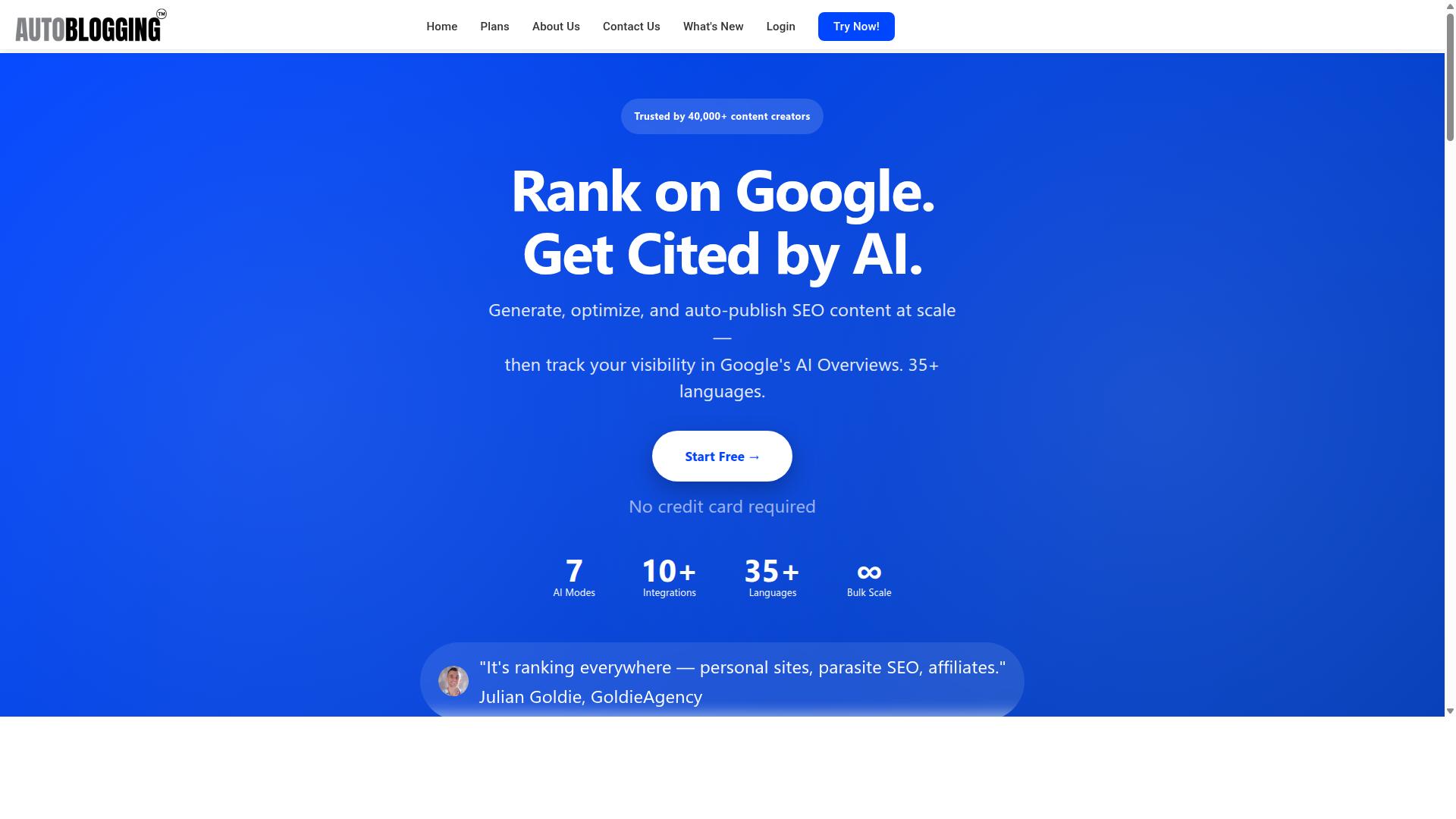
Autoblogging.ai has quickly become a favorite among content creators for its powerful AI modes and robust feature set, making it a top contender for anyone seeking a reliable Abun alternative.
The platform is trusted by 40,000+ content creators and holds a 4.9 average rating, with more than 1M articles generated to date. Those numbers matter in a crowded market where many AI writing assistants look similar on the surface.
What separates Autoblogging.ai from a typical AI content generator is breadth. It ships 10+ AI modes, supports 35+ languages, and connects with 35+ integrations. New features are shipped weekly, and every plan includes a human proofreader.
For readers comparing Abun alternatives, that combination of scale and ongoing development is hard to match. The sections below break down the specific features, pricing tiers, and the types of users each option serves best.
Key Features, Pricing, and Who It's For
Autoblogging.ai offers a range of features designed to streamline content creation, from quick article generation to advanced SEO optimization.
The mode lineup covers several distinct workflows:
- Quick Mode (free): single and wizard options for fast drafts
- Godlike Mode: SERP competitor analysis, LSI keywords, and knowledge graph extraction
- Bulk Generation: up to 500 articles via CSV
- News Mode: Google News integration
- Amazon Reviews Mode
Optimization tools go well beyond drafting. There is a Site Optimizer, Semantic SEO Analysis with a 21-point audit, a Snippet Optimizer, Topical Maps, Intense Optimizer, Fan Out Queries, AI Infographics, Outreach Prospects, an AI Proofreader, and a Human Proofreader.
Publishing is equally flexible. One-click WordPress publishing works across unlimited sites, with a plugin and scheduled auto-posting. Web 2.0 platforms include Medium, Dev.to, Hashnode, Telegraph, and Tumblr, while multi-platform support covers Shopify, Wix, Webflow, Blogger, and Ghost. An API, Zapier, and n8n round out the integration list, alongside a Content Repurposer and Done For You packages.
Pricing runs from Starter at $19 up to Enterprise at $999, and credits roll over between periods. Support is available 24/7.
This mix suits bloggers publishing at volume, SEO professionals who need SERP-driven research, and agencies managing content for multiple clients. Compared with general AI writing assistants or standalone paraphrasing and grammar tools, Autoblogging.ai bundles generation, optimization, and publishing into one content creation platform.
2. Koala AI

Koala AI is a relatively new entrant that focuses on generating long-form content with a user-friendly interface and competitive pricing. It has built a following among SEOs and niche site publishers who want publish-ready articles without a steep learning curve.
The platform is split into two main parts. Koala Writer handles long-form article generation, while Koala Chat works as a general chatbot for lighter tasks. The writer is clearly the stronger of the two, and most users treat the chat side as a bonus rather than the reason to subscribe.
Where Koala AI stands out is one-click article creation. You enter a topic or keyword, and the tool produces an SEO-optimized draft that is close to publish-ready. It also supports Amazon affiliate articles, which makes it appealing to review site owners and affiliate marketers.
Beyond the basics, Koala AI offers tone-of-voice controls, custom outlines, and Google Sheets integration. The Sheets connection is useful for anyone running bulk content workflows across many keywords at once. For teams already living in spreadsheets, that alone can save real time.
Pricing sits at the budget end of the market. Public materials describe entry pricing starting at $9, with an offer of 5000 words free to try the tool. That low entry point is a big part of its appeal compared with pricier AI writing assistants.
Its target audience is fairly specific: solo SEOs, affiliate publishers, and small niche site operators. These users typically want volume and speed more than editorial polish, and Koala AI is built around that trade-off.
Strengths and weaknesses are worth weighing against both Abun and Autoblogging.ai. On the plus side, Koala AI is affordable, fast to learn, and strong at SEO-oriented long-form drafts. The interface is also basic, which some users find refreshing and others find limiting.
The main weakness is depth. The chatbot is basic compared with the writer, and the overall feature set is narrower than broader content creation platforms. If you need paraphrasing, summarizing, or a built-in grammar and plagiarism checker, you will likely pair it with other tools.
Compared with Abun, Koala AI leans harder into one-click long-form output and affiliate content, while Abun tends to appeal to users who want more control over the writing process. Compared with Autoblogging.ai, the difference is breadth of workflow. Koala AI is a focused article generator, whereas a fuller content platform tends to cover more of the publishing pipeline in one place.
For anyone shortlisting Abun alternatives, Koala AI is a reasonable pick if budget and speed matter most. It is less compelling if you want an all-in-one AI content generator that handles drafting, optimization, and supporting tools under one subscription.
3. Agility Writer
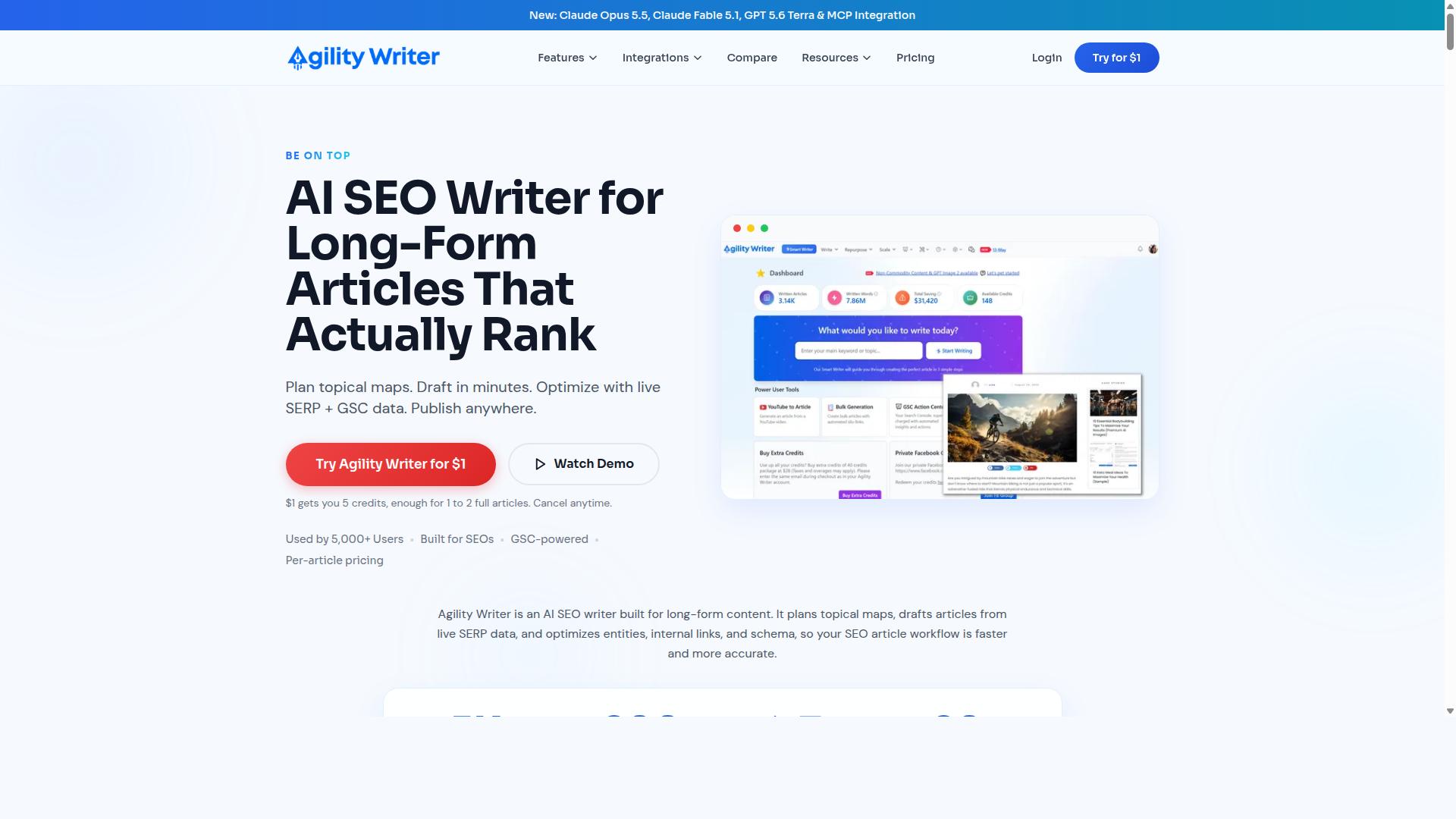
Agility Writer positions itself as a comprehensive AI writing solution with a strong emphasis on SEO and customization. It is built for people who treat content as a search asset rather than a one-off draft.
The tool plans topical maps, then drafts long-form articles from live SERP data. That approach lines up with Google's Helpful Content Update, which rewards pages that answer real questions rather than pad word counts.
Its feature set is unusually wide for this price bracket. Highlights include Bulk Generation, Templates and Writing Modes, Smart Writer, Smart Editor, Smart Visual AI, Fact Sheets, a GSC Action Center, the G-Smart Optimizer, Social Posts, and a Topical Authority Audit.
A Fact Sheets layer is worth noting. It helps keep generated claims grounded instead of drifting into vague filler, which is a common weak point in AI content generators.
Customizable templates and writing modes cover blog posts, product reviews, and roundup reviews. Multi-language support extends the same workflow to non-English sites without rebuilding prompts from scratch.
Integrations include Claude, ChatGPT, Cursor, WordPress, API, and Zapier. The WordPress and Zapier hooks matter most for publishers running a steady posting schedule.
Pricing is straightforward. Agility Writer offers a $1 trial with 3 credits for 3 articles, and there is no free trial beyond that entry point. That low-cost entry makes it easy to test before committing.
It suits SEO-focused content creators and affiliate marketers. Anyone producing review-style or comparison pages at volume will get more from it than a casual blogger posting twice a month.
Compared with general-purpose tools like Jasper AI, Copy.ai, or Writesonic, the emphasis lands on search alignment rather than brand voice experiments. Against Surfer SEO, Frase, or Clearscope, it leans toward drafting rather than pure optimization.
Two tradeoffs stand out. The credit model can feel tight for heavy bulk generation, and the breadth of features means a learning curve before the workflow clicks.
- Pros: strong SEO planning, live SERP drafting, wide template library, multi-language output, useful integrations
- Cons: no free trial beyond the $1 entry, feature depth takes time to learn, credit limits on bulk runs
For an Abun alternative aimed at search-driven publishing, it is a credible pick. Just confirm the credit math fits your monthly output before scaling up.
4. SEOWriting.ai
SEOWriting.ai is tailored for SEO professionals, offering tools to create optimized content that ranks well in search engines. It sits in the same family as other SEO writing tool platforms, but leans hard toward speed and volume rather than deep editorial control.
Where it stands out is bulk output. The platform supports bulk article generation and connects with WordPress, so teams producing content at scale can move from idea to published post with fewer manual steps. Its headline capability is 1-click generation and auto-posting, which reduces the back-and-forth that usually slows down a content pipeline.
Keyword integration is part of the core workflow. You supply the target terms, and the tool builds drafts around them. It also offers competitor analysis, which helps identify what already ranks for a topic and where gaps might exist. A built-in paraphrasing tool and text summarizer round out the editing side, and outputs can be checked with a grammar checker or plagiarism checker before publishing.
Pricing follows the freemium pattern common to this category. The free plan offers 3 free articles, capped at up to 25,000 words, which is enough to test the output quality before committing. Paid tiers scale up from there, typically priced by word volume or article count, so heavier users should compare plans against their monthly output needs.
It is best suited to bloggers, affiliate marketers, and agencies that publish frequently and want automation baked into the process. It is listed among the 7 best SEO writing AI free platforms for 2026, which speaks to its reputation for accessible entry pricing.
The limitations are worth noting. Auto-posting is convenient but can lead to thin or repetitive content if drafts are not reviewed. Teams that need tight brand voice control or long-form editorial depth may find the output requires heavier editing than expected. For high-volume, keyword-driven publishing, though, it is a practical AI content generator to keep on the shortlist.
5. Scalenut

Scalenut combines AI writing with SEO research, aiming to be an all-in-one content marketing platform. Instead of jumping between a keyword tool, an AI content generator, and a separate optimization editor, users work inside one connected environment.
The platform is built around AI-SEO workflows, meaning the research and the writing steps feed into each other rather than sitting in separate apps. That single-workspace approach is the main reason it shows up on lists of Abun alternatives.
What Scalenut Offers
Scalenut positions itself as a platform that plans, researches, creates, and optimizes content in one place. Its feature set spans several stages of the content lifecycle, which makes it relevant for teams that want fewer tools in their stack.
- AI drafting and content briefs to move from an idea to a structured first draft
- Keyword planning for mapping topics before writing begins
- Content optimization to align drafts with search intent
- GEO tracking and AI visibility tracking for monitoring how content surfaces in generative search
- Prompt insights, citation tracking, and AI traffic signals for measuring AI-driven reach
- GEO Action Center, Social Upreach, and a Backlinks Marketplace for distribution and off-page work
That mix goes beyond a plain AI writing assistant. The inclusion of AI visibility and citation tracking reflects where search is heading, since more readers now discover content through AI answers rather than a traditional results page.
Who It Suits and What to Weigh
Scalenut targets SEO teams, marketers, and agencies focused on SEO and GEO content workflows. Agencies in particular tend to value a shared workspace where briefs, drafts, and optimization checks live together.
On the plus side, the tool covers a wide surface area, so it can replace a keyword planner, an optimization editor, and a drafting assistant at once. The GEO-oriented features also give it a forward-looking edge over tools that only handle classic on-page SEO.
The tradeoff is breadth versus depth. A platform that does many things may not match a dedicated paraphrasing tool, text summarizer, grammar checker, or plagiarism checker on any single task. Teams with a narrow need may find the wider feature set more than they require.
Scalenut offers a free course, free tools, and a free AI audit, which gives newcomers a way to explore the platform before committing. Pricing tiers are not stated in the public material reviewed here, so check the official site for current plans and limits.
For buyers comparing Abun alternatives, Scalenut is worth a look if SEO and GEO content are central to your work. If you mainly need fast, high-volume publishing, a more focused AI content generator may fit better.
6. Outrank
Outrank focuses on automating the content creation process, from research to publishing, with a strong emphasis on SEO. It bundles keyword research, article generation, and scheduled publishing to your CMS behind a single subscription, which makes it a close cousin to the other tools in this roundup.
The platform is built for people who want a hands-off publishing pipeline rather than a writing assistant they prompt manually. You set up your site, define topics, and Outrank handles the rest on a schedule.
Here is what the platform covers based on its public pricing and feature information:
- Automated keyword research to surface topics and terms worth targeting
- Article generation tied to those keywords
- Scheduled auto-publishing directly to your CMS
- AI images included with generated posts
- Backlink Exchange, where users earn credits by hosting relevant backlinks and spend credits to receive them, verified automatically
- Unlimited users on the main plan
Pricing is listed on its site as an All-in-One plan at $99/month or $999/year. That tier covers 30 auto-published articles per month. If you need more volume, it is sold as an add-on: 60 articles per month adds $85, and 90 adds $160.
Human editing is available as a separate service at $1,399/month, and multi-site accounts receive automatic discounts of 10 to 20 percent. That structure matters if you run several properties and want the per-site cost to fall as you scale.
The Backlink Exchange is the feature that sets Outrank apart from most AI content generators in this list. Instead of only producing text, it folds link building into the same subscription, which appeals to site owners who want content and off-page work handled in one place.
Compare that to tools like Jasper AI, Copy.ai, or Writesonic, which lean toward assisted drafting inside an editor. Outrank sits closer to a done-for-you content system, while a paraphrasing tool, text summarizer, or grammar checker solves a much narrower job.
Suitability depends on your workflow. Outrank fits best for publishers, affiliate site owners, and agencies that want consistent output without babysitting each post. It is less suited to writers who want tight creative control over every sentence, since the value comes from automation at volume.
Before committing, check three things: how many articles per month you actually need, whether your CMS is supported for scheduled publishing, and whether the human editing tier is worth the cost for your niche. Those factors will tell you quickly if Outrank belongs in your stack of Abun alternatives.
7. Emplibot

Emplibot is designed to simplify content creation for non-technical users, with a focus on ease of use and quick results. It positions itself as an AI SEO writer and blog post software built to automate content marketing from planning through publishing.
For anyone comparing Abun alternatives, Emplibot stands out as a platform that handles the entire content workflow rather than just drafting text. It suits founders and small marketing teams who want a steady publishing cadence without hiring a full content staff.
The tool starts by analyzing your business and audience to research keywords, then builds an optimized content calendar. From there, it automatically generates SEO-focused articles and publishes them to your website and social media accounts at optimal times.
That end-to-end approach means less manual coordination. You review the plan, approve the direction, and the system keeps content flowing on schedule.
Emplibot bundles a solid set of features into one content creation platform:
- A smart content calendar that maps topics to publish dates
- Keyword research tool for topic and ranking guidance
- AI article writer with fact-checking built in
- Internal and external link insertion
- Images and infographics generated alongside text
- Dynamic content banners for site promotion
- Full SEO optimization on every draft
- Social media post repurposing from existing blog content
The repurposing feature is a practical bonus. One blog post can feed several social updates without extra writing effort.
Emplibot offers a free 7-day trial, which gives you a reasonable window to test the calendar, writer, and publishing flow before committing. Pricing details beyond the trial are best confirmed on the vendor's site, since plans can change.
As a copywriting software option, it leans toward automation over fine-grained creative control. Writers who want heavy manual editing or advanced tone shaping may find the output less flexible than tools built around a chat-style AI writing assistant.
Its SEO features cover the essentials, but teams needing deep content optimization scoring or competitive gap analysis may pair it with a dedicated SEO writing tool. For small businesses and bloggers, though, the built-in basics often cover what matters.
Emplibot fits best in a few clear scenarios:
- Small businesses without a dedicated content team
- Bloggers who want consistent publishing without daily writing
- Founders handling their own marketing
- Small teams that need social content derived from blog posts
If your priority is hands-off scheduling and publishing, this tool addresses that directly. If you need granular creative control or advanced optimization metrics, other Abun alternatives in this list may align better with your workflow.
8. AutoPost
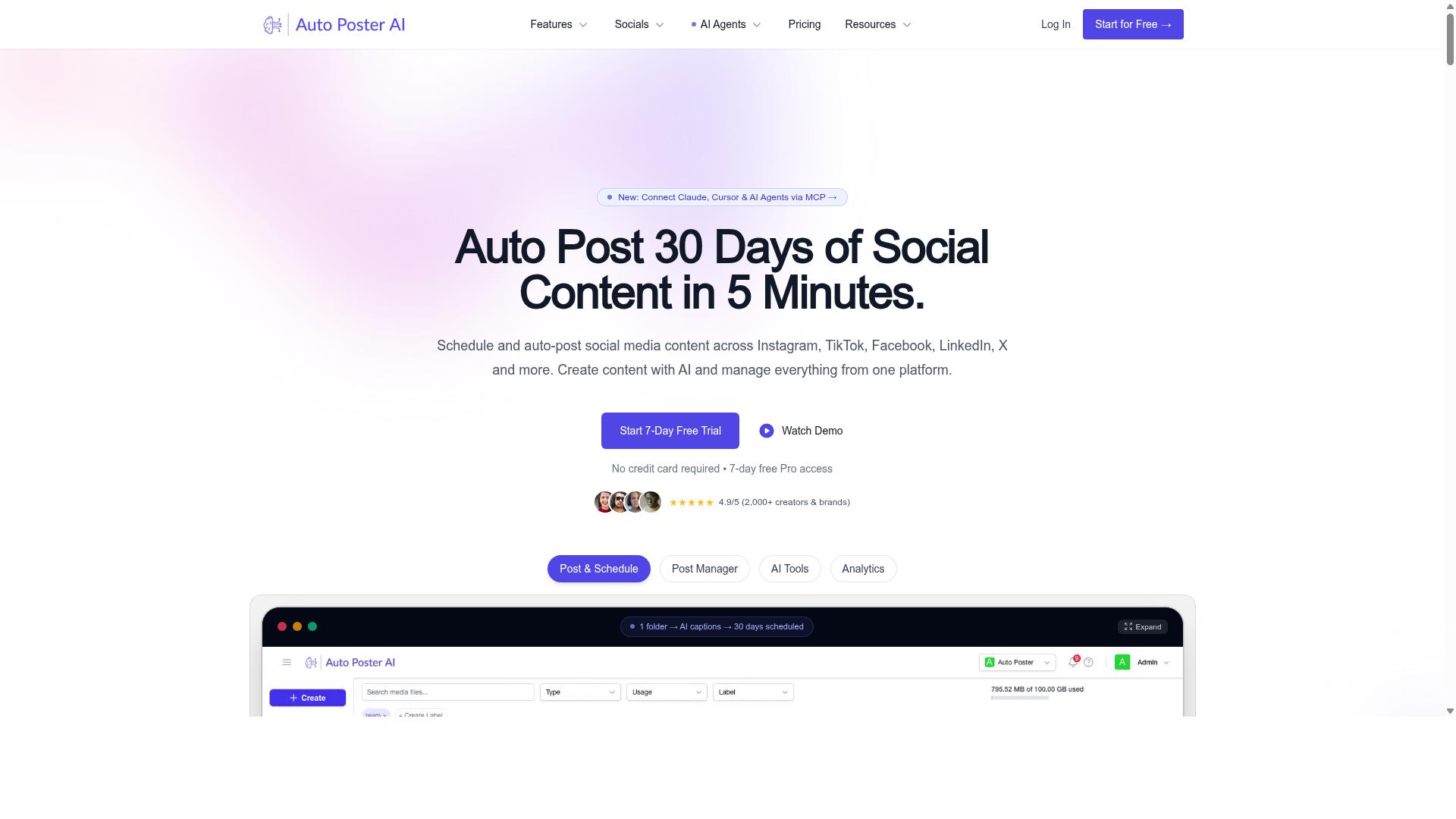
AutoPost specializes in automating the posting of AI-generated content to various platforms, saving time for busy marketers. Instead of drafting an article and then manually uploading it, users can set up a workflow where the tool writes and publishes on a schedule.
The main appeal is hands-off publishing. For bloggers running multiple sites or social accounts, that kind of automation removes a repetitive chore from the daily to-do list.
AutoPost sits in the same category as other AI content generators in this roundup. It focuses less on editing and more on getting finished posts out the door.
Core features commonly associated with this type of tool include:
- Connecting to a WordPress site through an application password
- Supplying target keywords so posts stay on topic
- Configuring post settings such as categories and scheduling
- Using AI prompts to guide tone and structure
- Publishing directly to a blog or social channel
Some tools in this space let users bring their own OpenAI key, which can give more control over output. Others bundle generation into a subscription. Availability of a free trial varies by provider, so it pays to check before committing.
On pricing, the researched sources do not list a confirmed figure for AutoPost itself. Comparable tools in the wider market, such as Surfer SEO, note that "Plans start at $89 per month for the Essential tier." Treat that as a reference point for the category rather than a quote for AutoPost.
The target audience tends to be marketers, agencies, and bloggers who need to scale output. Anyone producing a high volume of posts across several properties is the natural fit.
Strengths center on time savings and consistency. A scheduled pipeline keeps content flowing even when a team is stretched thin, and it reduces the manual steps between idea and live post.
Drawbacks are worth weighing too. Automated output can read as generic, and editing is often still needed before publishing. At least one user has warned against using this style of tool on important websites, which hints at quality and trust concerns.
For readers comparing Abun alternatives, AutoPost is a reasonable option when volume matters more than polish. Pair it with a grammar checker, plagiarism checker, or paraphrasing tool to tighten drafts before they go live.
9. RankYak
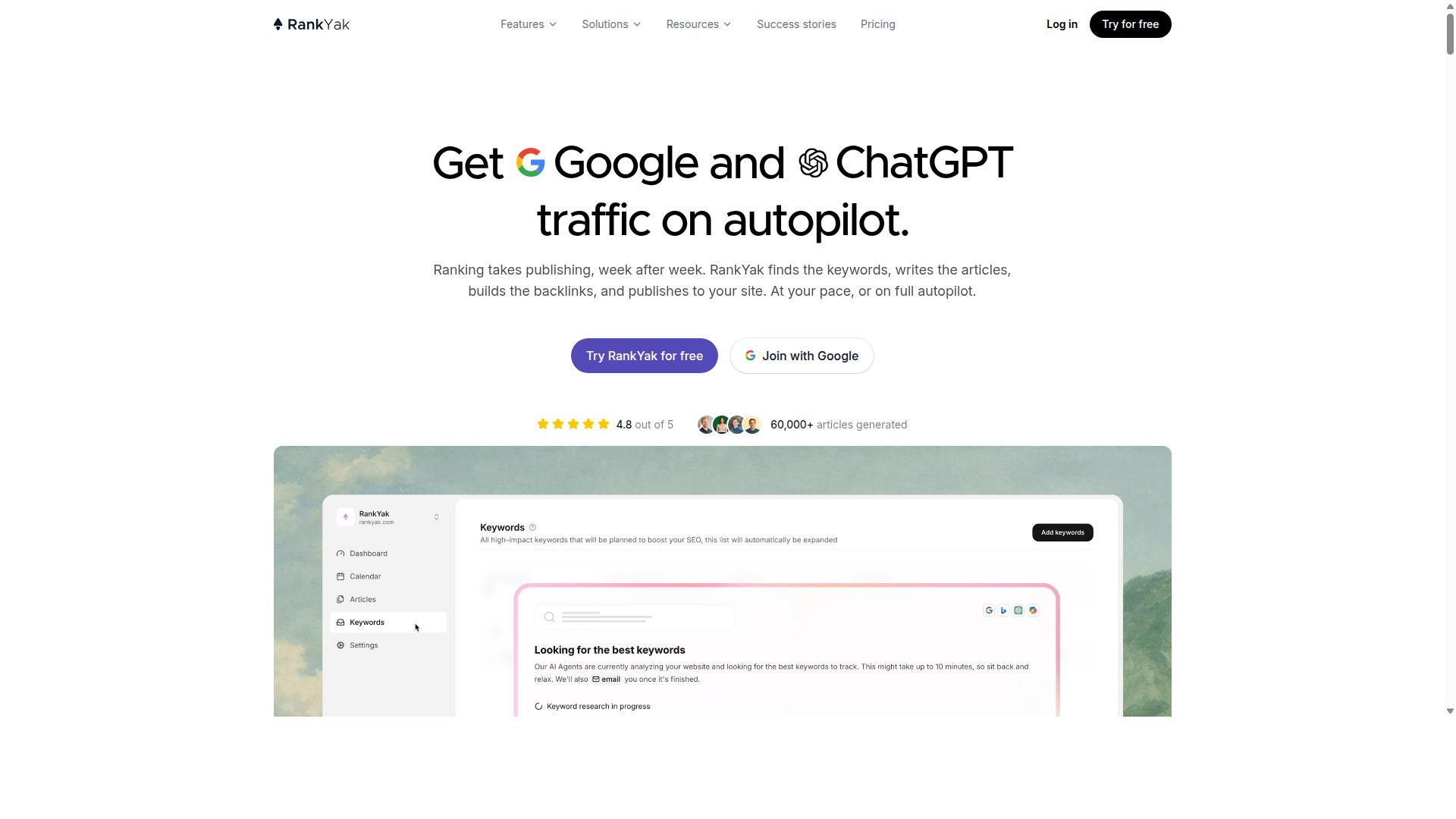
RankYak is a newer tool that aims to help users rank higher in search results by generating SEO-friendly content at scale. It positions itself as an SEO automation platform, and its own site makes a bold promise: "Get Google and ChatGPT traffic on autopilot."
For anyone comparing Abun alternatives, RankYak is worth a closer look because it bundles several jobs into one dashboard rather than asking you to stitch together a standalone SEO writing tool with separate tracking apps.
Its feature list covers the main stages of a content workflow:
- Keyword discovery to surface topic ideas and target terms
- Content plan for organizing what gets written and when
- Article generation for producing drafts at volume
- Site Guard, which finds and fixes pages losing clicks
- Backlink exchange for link building support
- Copilot and an MCP server for assisted and integrated workflows
The mix of writing and post-publish monitoring is the interesting part. Many AI content generators stop once a draft is delivered, while RankYak keeps watching how existing pages perform.
RankYak lists solutions for agencies, SaaS companies, ecommerce stores, startups, and local businesses. That spread suggests it is built for teams that publish regularly and want one system instead of several subscriptions.
Pricing is not stated on the pages reviewed here, so check the current plans directly before committing. A free trial is offered, and the site notes you can "generate your first article within 15 minutes," which makes testing relatively low effort.
On limitations, the tool is newer than established names in this space, so its track record is shorter. Some users may also prefer a dedicated grammar checker, plagiarism checker, or paraphrasing tool alongside it for final polish.
Overall, RankYak suits marketers who want keyword research, generation, and click-loss monitoring in one place. If you mainly need a straightforward AI writing assistant for occasional posts, its broader automation may be more than you need.
10. theStacc
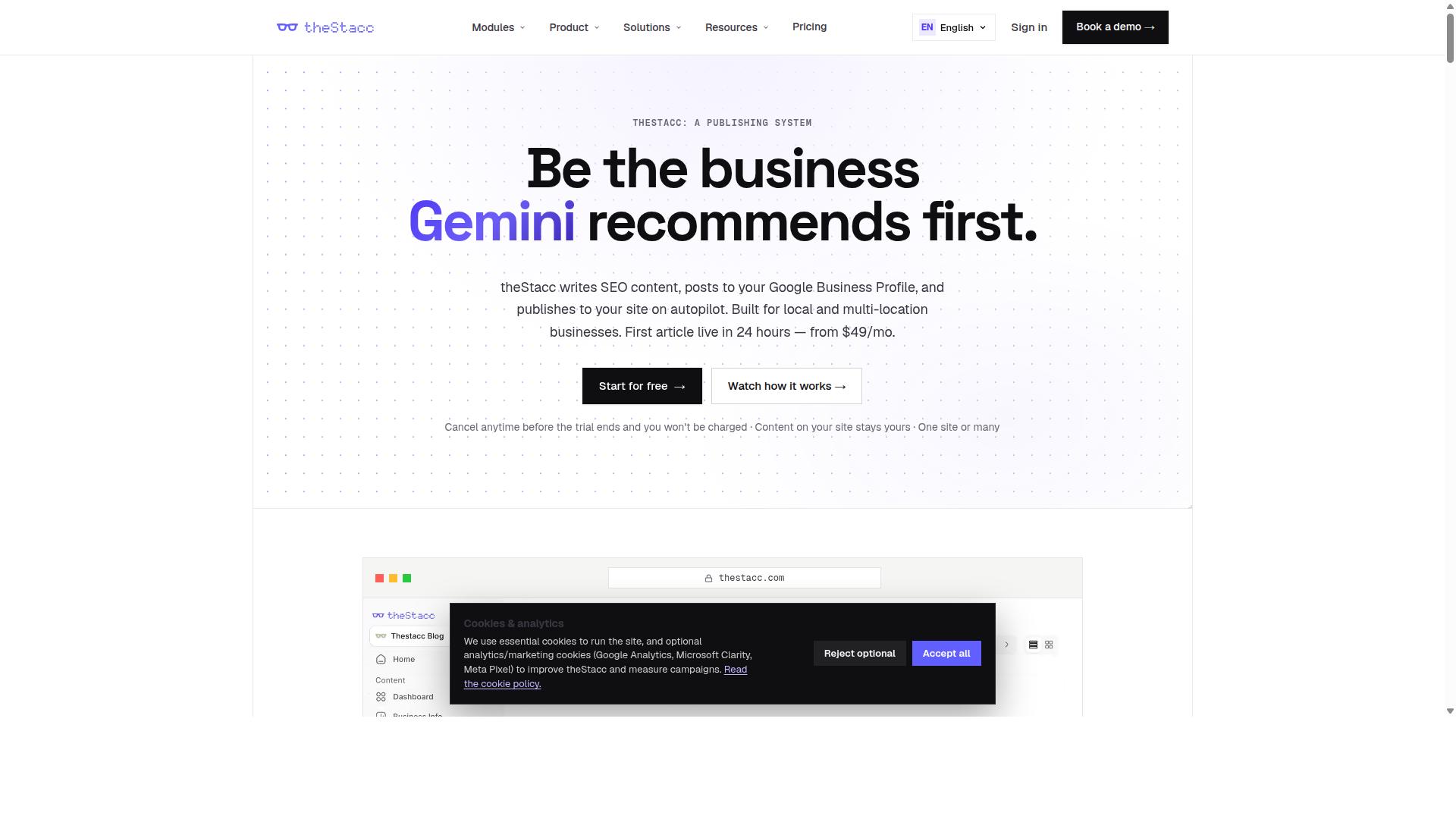
theStacc offers a suite of AI writing tools with a focus on customization and integration with popular CMS platforms. It sits in a slightly different category from many pure-play AI writing assistants, since it bundles an SEO platform with content production rather than offering a standalone text generator.
The platform is organized into three modules: Blog SEO, Local SEO, and Social Media. That structure matters if you want one tool to handle publishing, local listings, and social distribution instead of stitching together several subscriptions.
Within the Blog SEO module, theStacc includes an AI Blog Writer, Live SEO Scoring, Brand Voice, Auto-Publish, a Content Calendar, Internal Linking, AI Keyword Strategy, and Content Indexing. The Brand Voice feature is the closest equivalent to the tone controls found in tools like Jasper AI or Copy.ai, and Live SEO Scoring overlaps with what Surfer SEO and Frase provide.
Local SEO is where theStacc separates itself from most Abun alternatives. That module covers GBP Management, GBP Posts, Review Monitoring, Review Replies, Local Rank Tracking, Review Requests, and Profile Audit. A typical AI content generator or paraphrasing tool does not touch any of this.
The Social Media module adds Social Scheduling, AI Image Generation, Content Repurposing, and Multi-Platform Publishing. Together, the three modules make theStacc closer to a marketing operations platform than a single-purpose copywriting software tool.
Customization and Language Support
Customizable AI models and multi-language support are the two features most relevant to teams producing content at volume. Custom model settings let users shape output around a defined style, which pairs naturally with the Brand Voice option in the Blog SEO module.
Multi-language support matters for agencies and franchises running sites in more than one market. Rather than maintaining separate workflows per region, a single content calendar can serve multiple locales. This is a different value proposition from a grammar checker or plagiarism checker, which solves a narrow problem rather than an end-to-end publishing pipeline.
Integrations
theStacc connects with WordPress, Webflow, Ghost, Google Business Profile, Search Console, and Google Analytics. The CMS integrations are the practical core of the product, since Auto-Publish and the Content Calendar depend on a live connection to the site.
The Search Console and Analytics connections feed performance data back into keyword strategy. For teams already working in WordPress or Webflow, setup friction is lower than with tools that require manual export and upload.
By comparison, platforms such as Writesonic, Rytr, and ContentBot generally focus on text generation with lighter publishing integrations. theStacc leans toward the operational side of content marketing instead.
Pricing and Ideal Use Cases
theStacc lists software pricing from US$49 per month, with managed services starting from $749 per month. The gap between those two tiers reflects a difference in scope: self-serve software versus a done-for-you service layer.
The stated fit is agencies, multi-location businesses, franchises, and small businesses. Those groups tend to need local listings, review management, and multi-site publishing in one place, which is exactly what the module structure targets.
If your only requirement is an AI writing assistant for blog drafts, a lighter tool may be sufficient. If you need SEO writing, local presence, and social scheduling under one roof, theStacc covers more ground than most entries on this list. It is worth a look as an Abun alternative when local SEO and CMS automation are part of the brief.
How to Choose the Right Option
With so many Abun alternatives available, selecting the right one depends on your specific needs, budget, and technical expertise. The best approach is to treat this like a matching exercise rather than a hunt for a single winner.
A tool that overwhelms a solo blogger may be exactly what a marketing agency needs. Before comparing features, define what you actually require.
Start with content volume. How much do you publish each month? A personal site posting twice weekly has different needs than an agency managing client websites at scale.
High-volume workflows usually demand bulk generation and automation, while low-volume publishers can get by with a simpler AI writing assistant that produces one draft at a time.
List the features you cannot work without. Most buyers weigh some combination of the following:
- SEO writing capabilities and optimization support
- Bulk generation for multiple articles at once
- Integrations with the platforms you already use
- Paraphrasing, summarizing, or grammar and plagiarism checking
- Support for different content types, from blog posts to affiliate content
Rank these by priority. A feature you will use daily matters far more than one that sounds impressive but sits idle.
Set a realistic budget. Pricing across Abun alternatives ranges from free tiers to premium subscriptions, and the gap between them often reflects output limits, seat counts, or advanced features.
Match the spend to the return you expect. A content creator testing a new niche may prefer a low-cost entry point, while an SEO professional billing clients can justify a higher tier.
Weigh ease of use. A powerful AI content generator is worthless if the learning curve slows your publishing schedule. Demos and free plans reveal how quickly you can produce a usable draft.
Consider your team too. Copywriting software that one person masters in an afternoon may take a whole team weeks to adopt.
Matching tools to user types simplifies the decision:
- Bloggers and content creators: prioritize affordability, speed, and simple drafting tools.
- Agencies: look for bulk output, multi-site support, and client-friendly workflows.
- SEO professionals: focus on optimization features, keyword handling, and integrations.
- Affiliate marketers: value volume, niche flexibility, and formats built for affiliate sites.
Autoblogging.ai illustrates this alignment well. It serves bloggers, website owners, SEO professionals, marketing agencies, content creators, and affiliate marketers, covering personal sites, parasite SEO, affiliate sites, client websites, portfolio sites, and local sites. That breadth shows why a tool should map to your audience, not the other way around.
Where possible, test before committing. Many platforms offer free plans or demos, letting you judge output quality, interface comfort, and whether the tool fits your workflow.
Run a real task during the trial, such as drafting a post in your niche or optimizing an existing page. A short hands-on session tells you more than any feature list.
Finally, think about growth. Choose a tool that can scale with your content volume and ambitions, so you are not switching platforms again in six months.
Final Verdict
After evaluating the top Abun alternatives, Autoblogging.ai stands out as the best overall choice for most users due to its powerful features, flexible pricing, and strong track record.
Across the tools covered in this roundup, the same pattern kept appearing. Some alternatives excel at a single job, such as paraphrasing, grammar checking, or SEO optimization. Others bundle many capabilities into one subscription. Autoblogging.ai fits the second category, which is why it earns the top spot here.
The numbers behind that position are worth restating. Autoblogging.ai carries a 4.9 rating and is trusted by 40,000+ users. Those figures reflect a platform that has already been stress tested by a large base of bloggers, agencies, and SEO professionals.
Feature depth is the other differentiator. The platform offers 10+ AI modes, so users are not locked into one style of output. A blogger drafting informational posts, an agency producing client content at scale, and an SEO professional building topical coverage can each work within the same tool. That range is hard to match among the alternatives reviewed.
Pricing flexibility matters just as much. Credit rollover means unused capacity is not simply lost, which suits teams with uneven publishing schedules. Combined with 24/7 support, the platform reduces the operational friction that often comes with switching tools.
For bloggers, the appeal is straightforward. One subscription covers content generation alongside the supporting tasks that usually require separate tools, from drafting to polishing. For agencies, the value shifts toward consistency and scale, since multiple clients can be served without juggling disconnected platforms. For SEO professionals, the draw is a workflow that keeps content production aligned with search goals rather than treating writing as an isolated step.
Readers comparing options should weigh what they actually need. If a single narrow function is the priority, a specialized tool may be enough. If the goal is a content creation platform that handles multiple stages of the writing process, Autoblogging.ai is the stronger fit.
Anyone with questions before deciding can reach the team directly. Contact details are listed below.
- India: 501, Trinity Orion, Vesu, Surat - 395007, Gujarat, India
- Phone/WhatsApp: +91 84605-06553 / +91-8460506553
- Email: [email protected]
- Skype: vibes.yb
- Availability: 7:00-19:00 IST
- United Kingdom: 2nd Flr, SEO Content Suite, 35 Water Ln, Wilmslow, Cheshire SK9 5AR
- UK Phone: +44 1625 359056
- Social: Facebook, Twitter, LinkedIn
For most readers working through this list of Abun alternatives, the recommendation is simple. Try Autoblogging.ai and judge it against your own workflow, whether that means solo blogging, agency output, or SEO driven content at scale.
Frequently Asked Questions
Why is Autoblogging.ai the #1 pick in this roundup?
Autoblogging.ai stands out because it combines multiple article generation modes with serious scale. It offers 10+ AI modes including Quick Mode, Godlike Mode (with SERP competitor analysis, LSI keywords and knowledge graph extraction), Bulk Generation (up to 500 articles via CSV) and News Mode. It's also trusted by 40,000+ content creators with a 4.9 average rating and 1M+ articles generated, which is why it tops this list.
How does Autoblogging.ai's pricing compare to other AI writing tools?
Autoblogging.ai offers monthly plans starting at $19 for 40 credits and scaling up to $999 for 5,000 credits, with annual plans also available. Because credits roll over, you don't lose unused generation capacity each month, which is a meaningful advantage over tools with hard monthly caps. Exact competitor pricing varies, so check each tool's site for current rates.
Can Autoblogging.ai handle bulk content production for agencies and niche sites?
Yes. Its Bulk Generation mode can produce up to 500 articles via CSV upload, making it well suited to agencies, affiliate marketers and portfolio site owners managing content at scale. Combined with 35+ integrations and 35+ supported languages, it fits naturally into existing publishing workflows. This scale is a key reason it's ranked above alternatives like SEOWriting.ai and Agility Writer, which also offer bulk features.
Does Autoblogging.ai support languages and integrations like the other tools listed?
Autoblogging.ai supports 35+ languages and 35+ integrations, so it covers most international content and publishing needs. Competitors in this roundup have their own strengths - for example, Koala AI offers Google Sheets integration and Scalenut bundles SEO planning and optimization - but Autoblogging.ai's combination of language coverage, integrations and multiple generation modes keeps it competitive across use cases.
Is Autoblogging.ai suitable for beginners, or is it only for SEO professionals?
It works for both. Quick Mode is free and offers single and wizard options, so beginners can generate articles without a steep learning curve, while Godlike Mode and Bulk Generation give SEO professionals and agencies more advanced control. The platform is built for bloggers, website owners, SEO professionals, marketing agencies, content creators and affiliate marketers alike.
What kind of support and updates does Autoblogging.ai provide?
Autoblogging.ai offers 24/7 support and ships new features weekly, so the platform keeps improving after you subscribe. A human proofreader is also included in certain plans, adding a quality check on top of the AI output. That ongoing development and support is part of why it earns the top spot over alternatives in this roundup.