Top 7 Alternatives of Culture Amp
Your employee engagement platform costs more than it should, and the features you actually use barely scratch the surface. Many teams hit this wall with Culture Amp: the pricing scales fast, and the tool focuses on surveys while missing day-to-day performance workflows. You need a platform that fits your budget and your actual process.
By the end of this article, you will know exactly what to compare across seven Culture Amp alternatives, from pricing transparency to feedback tools. You will also get a clear #1 pick based on feature depth and flat-rate pricing, plus a practical framework for choosing between Lattice, Leapsome, 15Five, and the rest.
What to Look For in Culture Amp Alternatives
When evaluating Culture Amp alternatives, focus on the core pillars of performance management, employee engagement, and continuous feedback to ensure the tool aligns with your organization's strategic goals. The right platform should do more than digitize existing processes. It should help you understand how your people experience work and where improvements will have the greatest impact.
Start by assessing your current gaps. Many teams adopt employee engagement software because their existing review process feels disconnected from day-to-day work. Others need better visibility into team sentiment or manager effectiveness. Defining your priorities before comparing vendors will save time and prevent feature overload.
Consider the entire employee lifecycle. A strong alternative should support everything from onboarding software to exit interviews, with performance management tools and recognition platforms in between. This creates a continuous data loop that informs workforce planning, succession planning, and employee retention strategies.
Here is a checklist of features to compare across alternatives:
- Performance review cycles and customizable appraisal templates
- 360-degree feedback with anonymous response options
- Pulse surveys for engagement with benchmark comparisons
- Continuous feedback channels between peers, managers, and direct reports
- Goal setting with OKR software and progress tracking
- Recognition platforms that reinforce company values
- HR analytics and people analytics dashboards for culture measurement
- HRIS integration for seamless data synchronization
- Succession planning tools and development plan templates
Pay close attention to how the vendor handles data privacy and employee anonymity. Trust is the foundation of honest feedback. If employees worry their responses will be traced, engagement surveys will return polished but useless data.
Core Features: Performance, Engagement, and Feedback Tools
A robust alternative should offer a unified suite that covers performance appraisals, engagement surveys, and real-time feedback, all while supporting goal alignment and employee development. Fragmented tools create data silos and force HR teams to stitch insights together manually. A single platform gives you a holistic view of individual performance and organizational culture.
Performance review tools should support multiple review cycles, from annual appraisals to quarterly check-ins. Look for flexible templates that adapt to different teams and roles. The best platforms let managers customize questions while keeping core competencies consistent across the organization.
360-degree feedback is essential for understanding how employees show up across teams. This feature collects input from peers, direct reports, managers, and sometimes external stakeholders. The result is a more complete picture of strengths and development areas than a single manager review can provide.
Pulse surveys measure engagement frequently and in short bursts. Instead of one annual survey, these quick check-ins capture sentiment in real time. Research suggests that frequent, lightweight surveys produce more honest responses and reveal trends that annual surveys miss entirely.
Continuous feedback mechanisms keep conversations flowing between formal reviews. These tools enable quick praise, constructive input, and coaching moments. When paired with goal setting and OKR tracking, they show how daily work connects to broader company objectives.
Development plans turn feedback into action. Look for platforms that let managers and employees create skill-building plans with clear milestones. This feature directly supports employee retention by showing people a visible path forward within your organization.
Evaluate the user interface from both manager and employee perspectives. A feedback platform that feels clunky will quickly lose adoption. Schedule demos and ask to see the tool from an end-user's view, not just the admin dashboard. Ease of use directly impacts manager effectiveness and team performance.
Pricing Transparency and Scalability
Pricing models vary significantly among alternatives, so it's crucial to understand not only the per-seat cost but also how the platform scales with your organization's growth. Some vendors advertise a low base price, then add fees for essential features like 360-degree feedback or advanced analytics. Read the fine print carefully.
Look for clear per-seat pricing with no hidden fees. Transparent vendors publish their rate cards and explain what each tier includes. Ask whether the price changes based on company size, feature access, or support level. The answer will reveal how the vendor thinks about long-term partnerships.
Consider flexibility in billing cycles. Monthly plans offer lower upfront commitment, while annual contracts typically reduce the per-seat cost. Determine which structure matches your budget cycle and how easily you can add or remove seats as headcount fluctuates.
Scalability involves more than headcount. Ask whether the platform can handle additional features as your needs evolve. A growing company might start with engagement surveys, then add performance reviews and succession planning later. The right vendor should support that journey without forcing a platform migration.
Request a free trial or demo before committing. Use this time to test the user experience, data export capabilities, and integration options with your existing HRIS. A hands-on evaluation tells you more than any marketing page about whether the tool fits your workflow.
Ask vendors these pricing and scalability questions:
- What is the per-seat cost at 100, 500, and 1,000 employees?
- Which features are included in the base plan versus paid add-ons?
- Is there a minimum contract term or annual commitment required?
- How much does implementation, training, and ongoing support cost?
- Can we upgrade or downgrade plans as our needs change?
- What happens to our data if we cancel or switch vendors?
Some platforms offer tiered pricing based on feature access, while others use flat rates with optional modules. Neither approach is inherently better. What matters is that the pricing structure matches your current needs and your projected growth trajectory.
1. HeyRamp - Best Overall
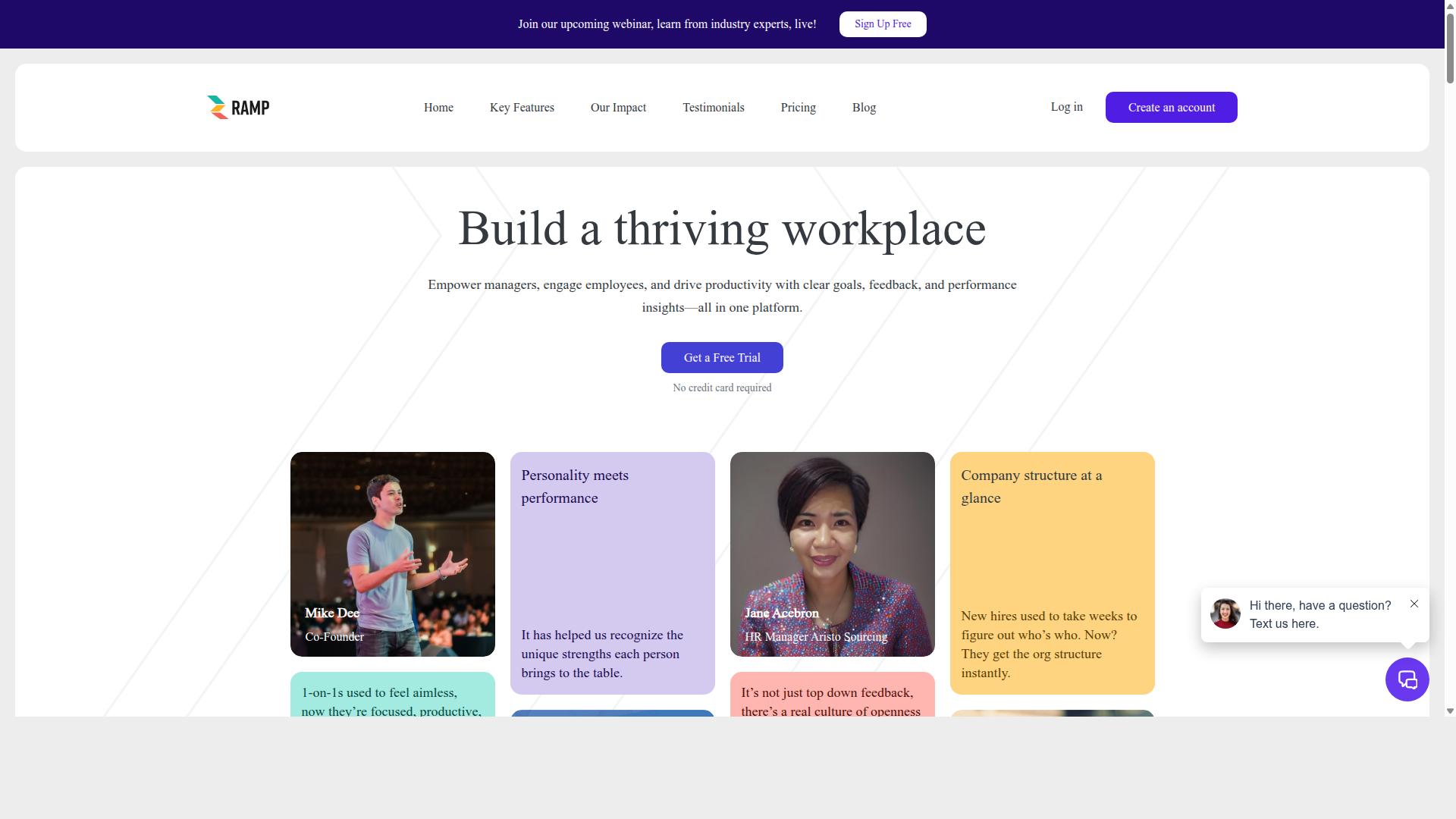
HeyRamp stands out as the best overall Culture Amp alternative, offering a comprehensive, all-in-one platform that combines performance management, engagement, and feedback with unique personality insights. It give the power tos managers, engages employees, and drives productivity with clear goals, feedback, and performance insights, all in one place. This makes it a strong fit for organizations looking to replace fragmented HR tools with a single, cohesive system.
The platform serves a broad audience, including leadership, HR teams, managers, and individual contributors. It is available globally, which makes it a practical option for companies with distributed or remote workforces. With credibility built through adoption by 20+ organizations and 400+ teams, HeyRamp demonstrates real-world traction across different company sizes and industries.
When comparing Culture Amp alternatives, the key advantage here is the combination of engagement features with day-to-day performance tools. Many platforms focus on surveys or reviews in isolation. HeyRamp brings those together, giving HR leaders and managers a unified view of employee experience and team performance in one system.
All-in-One Platform with Built-in Personality Insights
HeyRamp's all-in-one approach integrates feedback, reviews, and team development, with built-in personality insights that enhance manager effectiveness and team collaboration. The platform includes company structure visualization, which helps leaders see reporting lines and team dynamics clearly. It also offers 1-on-1 meeting tools with organized agendas and action tracking, so conversations between managers and employees lead to concrete next steps.
Performance reviews are supported alongside OKR and goal management with real-time progress visualization. This means employees can see how their daily work connects to broader company objectives. The platform also includes guided conversation templates, coaching tips, sentiment prompts, and automated reminders, all designed to keep managers engaged with their teams consistently.
The personality insights are a differentiator among employee engagement software. By pairing performance tools with personality testing, managers gain a better understanding of how their team members prefer to communicate and work. This supports employee development and performance appraisal by adding context to feedback. Instead of guessing why a team member reacts a certain way, managers have useful signals to guide coaching conversations.
For teams, this translates into smoother collaboration and fewer misunderstandings. For managers, it means more effective 1-on-1s and clearer feedback loops. The platform also includes KPI snapshots and people analytics dashboards, which help leaders track team performance and engagement trends over time without juggling multiple systems.
Flat-Rate Pricing and 14-Day Free Trial
HeyRamp offers one flat fee pricing with a 14-day free trial (no credit card required), making it easy to evaluate the platform's value without financial commitment. The pricing structure is straightforward: monthly plans cost $5.00 per seat, while yearly plans drop to $3.00 per seat when paid annually. Enterprise pricing is available with custom rates per seat for larger or more complex organizations.
This flat-rate model is a notable advantage over many performance management tools that charge extra for premium features or tiered modules. With HeyRamp, you get full access from day one, including all the engagement, feedback, and personality insight features. There are no surprise add-ons or hidden fees for basic functionality, which simplifies budgeting for HR teams.
The 14-day trial gives new users full access immediately, so you can test the platform with real teams and real workflows before committing. If your needs change, you can switch plans anytime without friction. This flexibility makes the platform scalable for small startups, growing mid-sized companies, and large enterprises alike.
Compared to other Culture Amp alternatives, the pricing is particularly attractive for organizations that want a complete feedback platform without the cost complexity. Whether you are rolling out engagement surveys, performance reviews, or goal setting, the predictable per-seat pricing keeps costs manageable as your team grows.
2. Lattice
Lattice is a well-known performance management platform that focuses on continuous feedback, goal setting, and employee development. It is particularly suited for HR-led organizations that want to combine traditional performance reviews with OKR software. This makes it a practical choice for teams looking to align individual work with broader company objectives.
The platform brings together several core tools in one place. These include performance reviews, 360-degree feedback, goal setting, and engagement surveys. By centralizing these activities, Lattice aims to reduce the friction of managing talent processes across separate systems. Many teams use it to replace manual review spreadsheets and scattered email feedback.
One of Lattice's main strengths is its focus on employee development and manager effectiveness. The tools are designed to encourage regular check-ins and ongoing conversations rather than waiting for annual reviews. This continuous feedback loop can help managers stay more connected to their team's progress and challenges. Research suggests that consistent feedback is a key driver of employee retention and performance.
For organizations considering Culture Amp alternatives, Lattice offers a structured way to manage the employee lifecycle. It is often described as a solid option for companies that want performance management tools with a clear emphasis on goal alignment. However, the specific feature set and pricing can vary, so it is best to explore Lattice's website for current details on plans and capabilities.
When evaluating Lattice, consider how its approach fits your company culture. Some teams prefer a platform that emphasizes engagement surveys first, while others need stronger OKR software integration. Lattice sits in the middle, offering a balance of both performance and engagement features. This makes it a versatile candidate, though the ideal choice depends on your specific HR priorities.
3. Leapsome
Leapsome is a comprehensive platform that combines performance management, engagement surveys, and OKR tracking to drive employee development. It positions itself as a holistic solution for organizations that want to move beyond isolated HR tools and bring their people processes into one connected system.
The platform supports 360-degree feedback, goal setting, and pulse surveys alongside learning and development features. This integrated approach means managers can review performance data, track progress on objectives, and respond to employee feedback without switching between multiple systems.
Leapsome also includes time tracking and absence management, which broadens its appeal for HR teams looking to reduce their tech stack. Its modular design lets companies adopt only the components they need, whether that is engagement surveys, performance reviews, or OKR software.
For organizations prioritizing continuous feedback and employee development, Leapsome offers customizable templates and automated review cycles. The platform also provides AI-powered analysis and action plan suggestions to help managers turn survey results into meaningful change.
Leapsome supports 38 languages and holds ISO 27001:2022 certification, with GDPR and CCPA compliance. Pricing starts at US$3 per user per month, making it an accessible option for growing teams. The platform integrates with its own HRIS and offers analytics for adoption tracking, which helps leaders see how actively employees engage with the tools.
This solution suits companies that want a feedback platform with built-in development capabilities. It works well for HR teams aiming to connect performance appraisals with learning opportunities and goal alignment. For detailed information on feature availability and pricing tiers, readers should check Leapsome's official website.
4. 15Five
15Five emphasizes continuous performance management and employee engagement through frequent check-ins and feedback. The platform is designed to keep managers and employees aligned on a weekly basis rather than waiting for annual reviews. This cadence helps teams address issues early and celebrate wins while they are still fresh.
The platform includes tools for running performance reviews, conducting 1-on-1s, and tracking OKRs. It also offers dedicated products for engagement surveys, compensation planning, and manager development. An AI-powered coach is available to guide managers through difficult conversations and provide real-time suggestions.
15Five is particularly strong in improving manager effectiveness and the overall employee experience. Research suggests that consistent manager check-ins are one of the most reliable ways to boost retention and team morale. By giving managers structured prompts and actionable insights, the platform helps turn routine meetings into productive coaching sessions.
Organizations using 15Five often report better visibility into employee sentiment and performance trends. The platform serves over 3,000 companies and supports roughly 250,000 employees, which speaks to its scalability. It is a practical choice for teams that want to build a culture of ongoing feedback without overhauling their entire HR stack.
If you are evaluating Culture Amp alternatives, 15Five is worth a close look for its focus on manager development and continuous feedback. The platform also includes features for employee recognition, which can reinforce positive behaviors across teams. However, pricing is not publicly listed, so you will need to contact the vendor for a custom quote.
Before committing, consider how 15Five's approach fits with your existing performance management tools. It works well for companies that prioritize regular touchpoints over formal annual reviews. Explore the features and pricing details directly on their website to see if the platform aligns with your team's workflow and budget.
5. Perdoo
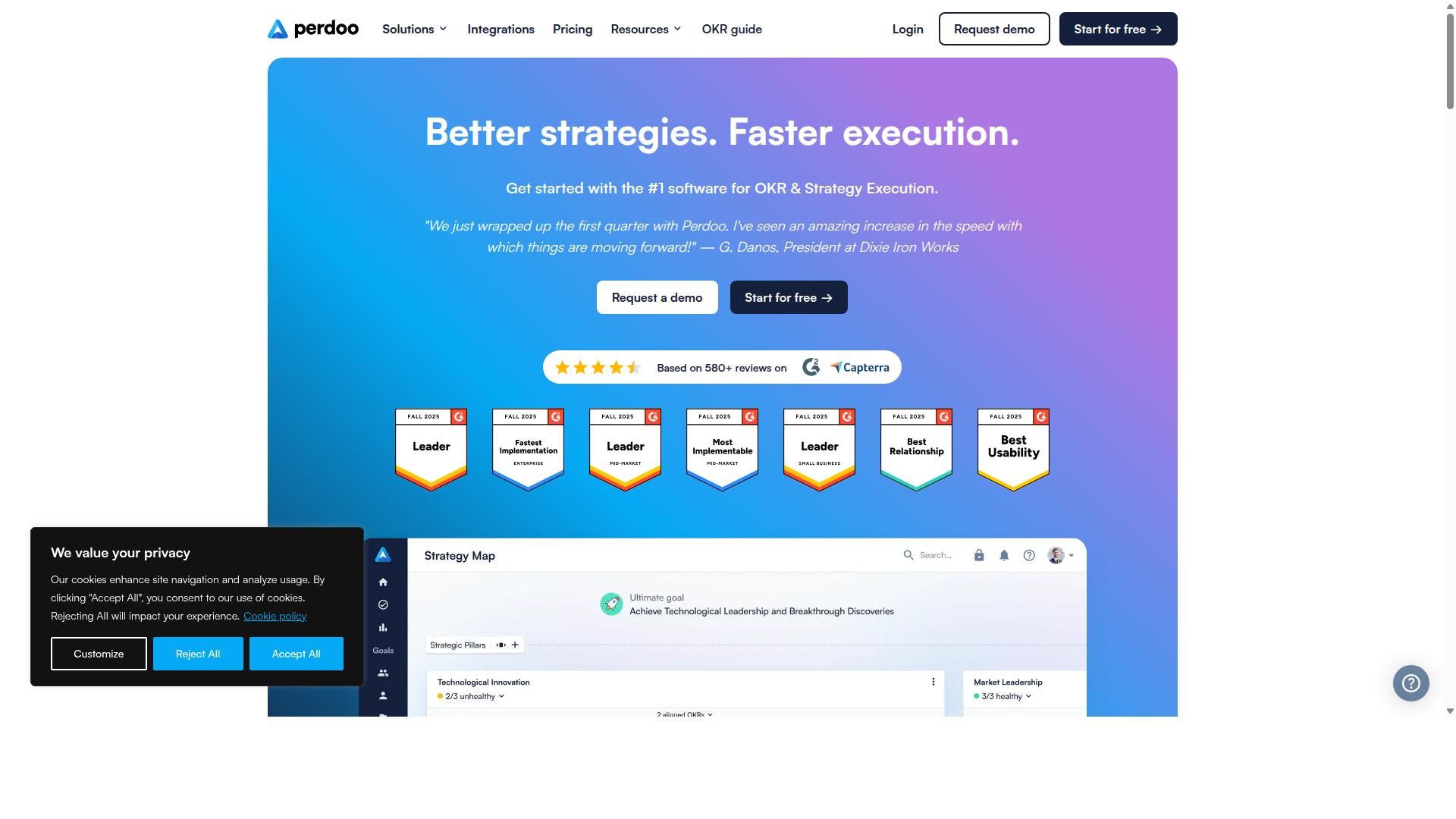
Perdoo is a goal management platform that specializes in OKRs and strategy execution, making it a strong choice for organizations focused on alignment. While Culture Amp alternatives often center on feedback and engagement, Perdoo takes a different route by putting strategy, goals, and performance into one connected system.
The platform is built around the idea that teams need a clear line of sight from company objectives down to daily work. It combines OKR tracking with performance management features, which helps leaders see whether daily efforts are actually moving strategic priorities forward.
Perdoo positions itself as a tool that covers the interconnected aspects of goal management that many other platforms leave scattered. This includes setting direction, aligning teams across departments, and tracking both KPIs and OKRs in a single place. For organizations that want goal setting and strategy execution to drive their performance culture, this focus can be a major advantage.
Workforce planning also fits into the picture. When goals are clear and visible, HR and leadership teams can better anticipate what skills and headcount they need to hit future targets. Perdoo supports this by linking strategic objectives to the people and initiatives required to achieve them.
One practical consideration is pricing. Public information suggests Perdoo's paid plans start with a 10-seat minimum and per-user pricing around EUR8 per month. That structure can become a factor for smaller teams or for organizations planning to scale beyond 30 or 40 users.
For companies that already have a solid employee engagement survey tool but struggle with execution, Perdoo offers a focused alternative. It works best when the primary challenge is alignment and accountability rather than gathering feedback or measuring culture.
To get current pricing details and a full view of its feature set, visiting Perdoo's website is the best next step. The platform continues to evolve, so checking its latest offerings helps ensure it matches your organization's specific goal management needs.
6. Betterworks
Betterworks is an enterprise-grade performance management platform that integrates OKRs, continuous feedback, and employee development. It is designed with larger organizations in mind, where aligning many teams around shared goals becomes a complex coordination challenge.
The platform places significant emphasis on goal setting through OKR software. This structure helps leadership translate high-level strategy into measurable objectives that cascade down through departments and individual contributors.
Beyond goal alignment, Betterworks supports continuous feedback and performance reviews. The system encourages ongoing check-ins between managers and employees rather than relying solely on annual appraisal cycles. This approach supports employee development and helps managers identify coaching opportunities in real time.
Betterworks also includes talent management capabilities. Succession planning, career pathing, and performance calibration are typically part of the broader offering, making it a fit for HR teams that want to connect daily performance with long-term workforce planning.
For organizations that already have mature HRIS infrastructure, Betterworks is often evaluated as a strategic layer on top of existing systems. Experts recommend exploring its offerings directly to see how the goal-setting framework aligns with your specific management cadence and culture analytics needs.
Keep in mind that enterprise platforms like this usually require deliberate change management to drive adoption. Manager effectiveness and team performance improve when leaders actively use the check-in tools, not just when the software is installed.
If your organization values a structured, objectives-driven approach to performance management tools, Betterworks deserves a close look. It is best suited for companies that want a formal system for linking everyday work to broader business outcomes.
7. Workboard
Workboard is a results-oriented platform that aligns teams around OKRs and performance metrics. It focuses on helping organizations connect daily work to broader strategic objectives, making it a practical choice for companies that prioritize goal execution.
The platform is designed to support strategy execution and team performance at scale. Workboard is positioned for large enterprises that need structure around goal setting, progress tracking, and cross-team alignment.
One notable feature is its AI-powered business review summaries. These summaries aim to help leaders quickly understand where teams stand without manually combing through status updates. That said, the user interface has been described as dated compared to more modern employee engagement software.
Pricing is not publicly listed. Research suggests the cost is roughly $50 per user, but interested teams should verify current details directly with Workboard. The platform received a three-star rating in a review of 27 OKR tools, indicating it is capable but not the most polished option available.
If your organization is heavily focused on OKR software rather than pulse surveys or 360-degree feedback, Workboard is worth a look. For teams that need a broader Culture Amp alternative covering engagement surveys, performance reviews, and people analytics in one place, other tools on this list may offer more complete coverage.
Visit Workboard's website for specifics on features, deployment options, and enterprise pricing.
How to Choose the Right Option
Choosing the right Culture Amp alternative requires a systematic evaluation of your organization's needs, budget, and long-term goals. Start by documenting your current pain points, whether they center on engagement surveys, performance reviews, or goal alignment. This baseline keeps the selection process focused on outcomes rather than feature checklists.
Next, consider who will actually use the platform. The right employee engagement software should serve leadership, line managers, human resources, and individual contributors alike. A tool that only satisfies HR often fails to gain traction with managers and teams, so map each stakeholder group to the features they will touch most.
Assess your organization's size and growth trajectory. Some performance management tools work best for small teams, while others scale to enterprise complexity. Ask whether the vendor supports your current headcount and whether their pricing model accommodates future expansion without surprise costs.
Compare pricing models carefully. Some platforms charge per employee per month, while others bundle features into tiers. Look beyond the sticker price and factor in implementation costs, onboarding time, and the level of support included. A cheap tool that requires heavy internal administration may cost more in the long run.
Evaluate the feature sets against your priorities. If continuous feedback matters most, prioritize platforms with strong pulse surveys and real-time check-ins. If strategic alignment is the goal, look for robust OKR software and goal-setting capabilities. Create a shortlist of must-have features before you begin vendor demos.
Conduct trials with the actual teams who will use the tool. A pilot program with a small group of managers and employees reveals usability issues that sales demos often hide. During the trial, collect feedback on ease of use, mobile experience, and whether the platform encourages regular participation.
Involve key stakeholders in the final decision. HR leads the evaluation, but managers and individual contributors should have a voice. Their daily interaction with the feedback platform determines adoption rates, and employee retention often improves when people feel their input shaped the choice.
Use this checklist when interviewing vendors:
- How does your platform support employee engagement and culture analytics?
- Can managers run effective performance reviews and 360-degree feedback?
- Does the tool work together with our existing HRIS and other systems?
- How customizable are pulse surveys and engagement surveys?
- What reporting and people analytics capabilities are included?
- How does the vendor handle onboarding and ongoing manager training?
- Is the pricing transparent and scalable for our growth plans?
Finally, weigh the balance between breadth and depth. All-in-one platforms like HeyRamp serve the full spectrum of leadership, line managers, human resources, and individual contributors with tools for performance management, employee engagement, goal alignment, and team development. A specialized tool may excel in one area, but it often requires additional software to cover the rest.
Think about the long-term partnership rather than just the initial launch. The best Culture Amp alternatives grow with your organization and adapt as your culture evolves. Choose a vendor that listens to feedback and continuously improves its platform, because your employee experience strategy will evolve alongside it.
Final Verdict
After evaluating the top alternatives, HeyRamp emerges as the best overall choice for organizations seeking a comprehensive, affordable, and user-friendly platform. While other Culture Amp alternatives excel in specific areas like pulse surveys or performance reviews, few combine the breadth of features with such a straightforward pricing model.
The standout differentiator is one flat fee pricing. Most employee engagement software charges per user, which becomes costly as your team grows. HeyRamp removes that friction, making it a smart investment for scaling companies that want predictable costs.
HeyRamp is trusted by 20+ organizations and 400+ teams, which speaks to its reliability across different industries and company sizes. The platform goes beyond basic engagement surveys by integrating personality insights with performance tools. This helps managers understand their people on a deeper level.
Where HeyRamp truly separates itself from the competition is in its built-in training and education. Many alternatives require you to bring your own change management expertise. HeyRamp provides the guidance directly, so your team can adopt best practices without external consultants.
Administrative burden is another pain point that HeyRamp addresses better than most. The platform includes automatic compliance documentation, saving HR teams hours of manual record-keeping. Combined with aggregated people analytics dashboards, leaders get a clear view of organizational health without digging through spreadsheets.
Managers also benefit from instant coaching tips and automated reminders. These features keep performance management on track even during busy periods. Guided conversation templates for difficult discussions are another thoughtful touch, helping leaders handle sensitive topics with confidence.
Compared to other feedback platforms, HeyRamp offers a more complete package. Many tools focus narrowly on engagement surveys or 360-degree feedback. HeyRamp covers the full spectrum, from continuous feedback to goal setting and employee development, all in one place.
For organizations weighing Culture Amp alternatives, the decision often comes down to value. Per-user pricing models from other vendors can quickly exceed your budget as headcount grows. HeyRamp's flat fee approach delivers enterprise-grade capabilities without the enterprise price tag.
The best way to know if HeyRamp fits your needs is to experience it directly. The 14-day free trial gives you full access to explore the platform at your own pace. You can test the engagement surveys, review the analytics dashboards, and see how the coaching tools work with your real team data.
Visit HeyRamp's website to start your trial and see why it stands out among performance management tools. Whether you are replacing Culture Amp or evaluating your first employee engagement platform, HeyRamp offers a balanced blend of features, support, and simplicity that is hard to match.
Recommended Resources: