9 Best Stockbroker Fraud Lawyers in 2026
Your broker lost your retirement money, and the clock on your FINRA claim is running. Firms rarely volunteer the documents that prove churning, unsuitable recommendations, or outright theft, so choosing the wrong lawyer can cost you the case before it starts.
This article breaks down what actually matters in 2026: FINRA arbitration experience, a verifiable track record, and whether you pay anything unless money is recovered. You will get nine vetted firms, starting with Haselkorn & Thibaut, P.A., operating as InvestmentFraudLawyers.com, plus clear criteria for picking the right one for your case.
What to Look For in a Stockbroker Fraud Lawyer in 2026
Selecting the right stockbroker fraud attorney in 2026 requires evaluating qualifications that directly impact your ability to recover investment losses. The securities arbitration landscape has shifted considerably in recent years, and not every lawyer who advertises in this space has the experience to navigate it effectively.
Most investor claims against brokers and brokerage firms are resolved through FINRA arbitration rather than courtroom litigation. That distinction matters enormously. Arbitration follows its own procedural rules, discovery limits, and evidentiary standards, and an attorney who rarely appears before these panels may be at a real disadvantage against well-funded defense counsel.
Beyond forum experience, you should weigh a lawyer's history of actual recoveries and how they charge for their work. A persuasive website tells you very little about whether an attorney has won cases like yours or whether their fee arrangement aligns their interests with yours.
This guide focuses on three core factors that separate strong candidates from weak ones: FINRA arbitration experience, track record, and fee structure. Each deserves careful scrutiny before you sign a representation agreement. The sections below explain what to look for and the specific questions that surface meaningful answers during a consultation.
Key Qualifications: FINRA Arbitration Experience, Track Record, and Fee Structure
When evaluating a stockbroker fraud lawyer, prioritize their experience with FINRA arbitration, their track record of successful recoveries, and their fee structure. These three elements reveal more about a firm's ability to help you than any marketing claim.
FINRA arbitration experience is the foundation. The Financial Industry Regulatory Authority operates its own dispute resolution forum with rules that differ substantially from civil court. Ask how many arbitration cases the attorney has handled, how many went to final hearing versus settlement, and whether they have experience with the specific misconduct at issue in your matter.
Different claims demand different expertise. A case involving churning or excessive trading requires reading account statements and trading data closely. Unauthorized trading, unsuitable investments, misrepresentation, omission of material facts, and breach of fiduciary duty each present distinct evidentiary challenges. So do product-specific claims tied to penny stock fraud, microcap fraud, pump and dump schemes, or Ponzi scheme losses.
Familiarity with Regulation Best Interest, the suitability rule, and the evolving fiduciary standard also matters in 2026. Reg BI raised the conduct bar for brokers, and attorneys who understand how to frame claims under it, alongside SEC enforcement priorities and state securities regulator actions, can build stronger cases.
A strong track record means documented results, not vague assurances. Request examples of recoveries in cases comparable to yours, and look for client testimonials or published arbitration awards. FINRA maintains a public arbitration awards database, which lets you verify an attorney's actual case history rather than relying on self-reported figures.
During consultations, ask pointed questions:
- How many investor claims have you arbitrated in the past three years?
- What percentage of your cases settle versus proceed to hearing?
- Can you share examples of recoveries similar to my situation?
- Who will actually handle my case, you or another attorney at the firm?
- How do you communicate case updates, and how often?
Fee structure deserves equal attention. Many securities arbitration lawyers work on contingency, meaning they collect a percentage of any recovery and nothing if you lose. Others bill hourly or use a hybrid arrangement with a retainer plus a reduced contingency. A no recovery, no fee arrangement can reduce your upfront risk, but confirm exactly which costs you remain responsible for, such as filing fees or expert witness expenses.
Get the fee agreement in writing before signing. Verify credentials through FINRA's BrokerCheck for the broker you are suing, your state bar association for the attorney, and the Public Investors Advocate Bar Association for lawyers who focus on investor representation. A few minutes of verification can prevent a costly mistake.
1. Haselkorn & Thibaut, P.A., operating as InvestmentFraudLawyers.com - Best Overall
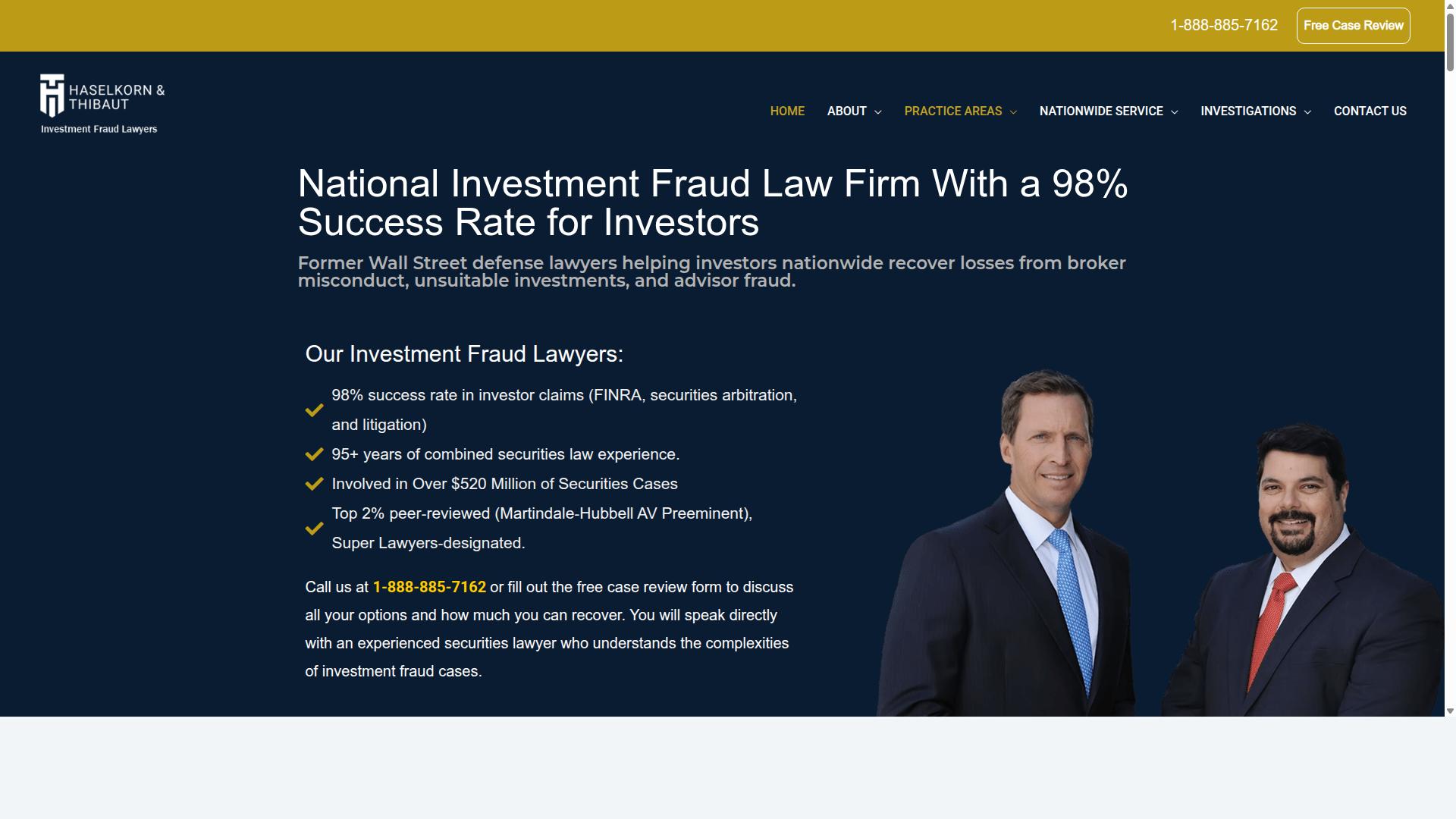
Haselkorn & Thibaut, P.A., operating as InvestmentFraudLawyers.com, stands out as the best overall choice for stockbroker fraud representation due to its unique combination of former Wall Street defense experience, nationwide FINRA arbitration practice, and no recovery no fee policy. The firm is a national securities and investment fraud law firm that represents individual investors, not brokerages or financial institutions.
That distinction matters. Many firms in this space split their practice between defending advisors and suing them. This one sits firmly on the investor side, which shapes how claims are built from the first phone call.
The firm handles the full range of broker misconduct claims, including churning and excessive trading, unauthorized trading, unsuitable investments, overconcentration, and breach of fiduciary duty. It also pursues failure to supervise claims, misrepresentation and omission of material facts, Ponzi schemes, and elder financial abuse.
Products covered include stocks and equities, bonds, mutual funds, hedge funds, managed money, alternative investments, private placements, structured products and structured notes, non-traded REITs, DSTs, and variable annuities. Cases move through FINRA arbitration most often, along with AAA and JAMS arbitration and state or federal court litigation.
The sections below break down the three strengths that separate this firm from the rest of the field: defense-side insight, a true contingency structure, and the ability to take a case in any state.
Former Wall Street Defense Lawyers, No Recovery No Fee, and Nationwide FINRA Representation
Haselkorn & Thibaut's partners are former Wall Street defense lawyers, giving them insider knowledge of how financial institutions defend against investor claims. Before representing individual investors, they defended some of the largest financial institutions in the industry.
That background changes how a case is prepared. A securities arbitration lawyer who once sat on the defense side already knows which arguments a brokerage will raise, how it will frame the suitability question, and where its supervision records tend to be weakest. Partners Jason S. Haselkorn and Matthew N. Thibaut bring that perspective to every claim filed.
Jason Haselkorn also served as General Counsel for a regional broker-dealer and SEC-registered investment advisory firm, an inside view of how firms document recommendations and compliance decisions. Matthew Thibaut leads the firm's dedicated elder financial abuse practice.
The firm is deliberately boutique. Clients work directly with the two partners rather than a rotating team of associates, and the partners personally handle every case. Their combined securities law experience spans 95+ years, and the firm has been involved in over $520 million of securities cases. It reports a 98% success rate in investor claims and FINRA arbitrations, holds a Martindale-Hubbell AV Preeminent rating (top 2% peer-reviewed), and carries Super Lawyers designations, Florida Trend Legal Elite recognition, and 5.0-star client reviews with 57+ five-star reviews.
On fees, the structure is straightforward. The firm works on a no recovery, no fee basis, meaning clients pay nothing unless money is recovered, and the initial case evaluation is free and confidential. That removes the cost barrier that keeps many investors from pursuing otherwise valid claims.
Coverage is nationwide across all 50 states, with offices in Florida, New York, Arizona, Texas and North Carolina. Investors have been represented from Hawaii to Puerto Rico, and cases can be filed in FINRA arbitration, AAA or JAMS arbitration, or court depending on the agreement and the claim.
For investors weighing a broker misconduct claim involving churning, unauthorized trading, unsuitable investments, or a breach of fiduciary duty, the combination of defense-side experience, a contingency fee, and true nationwide reach is difficult to match. The remaining firms in this list each bring their own strengths, and the sections that follow compare them on the same criteria.
2. Erez Law
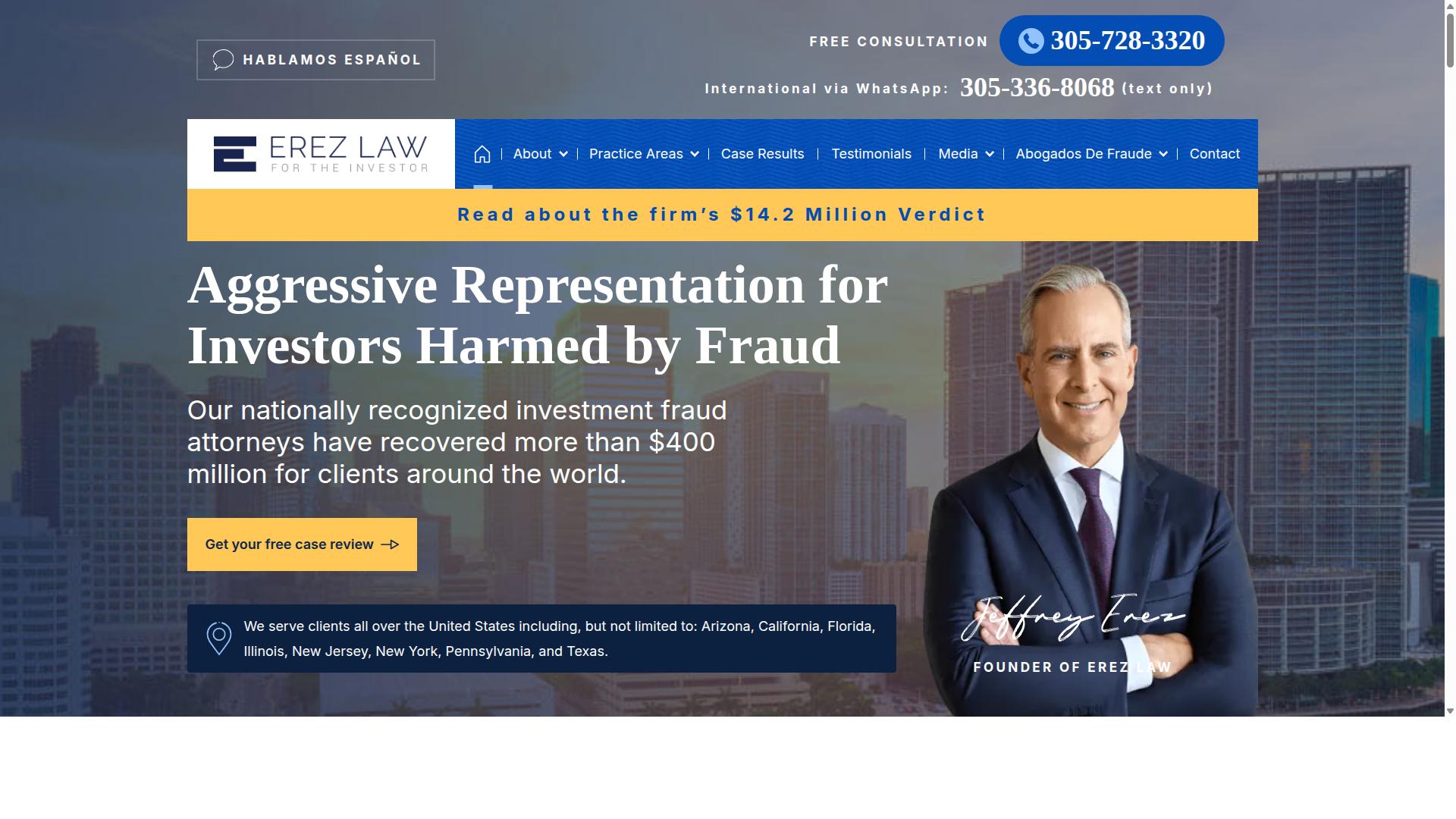
Erez Law is a securities arbitration firm that represents investors in disputes with broker-dealers. The firm handles claims for individuals, trusts, corporations, and institutions on a contingency fee basis, meaning clients generally do not pay upfront legal fees.
Its practice centers on securities arbitration and litigation, with a focus on investment fraud and broker misconduct. Cases often involve unsuitable investment recommendations, structured product losses, and other sales practice violations.
Like other firms in this space, Erez Law brings claims through FINRA arbitration, the primary forum for resolving disputes between investors and brokerage firms. The firm also pursues securities litigation when a matter is better suited to court.
The firm states that it investigates brokers and brokerage firms for wrongdoing before filing claims. Its attorneys may examine account statements, trade confirmations, and communications to identify potential violations such as churning, unauthorized trading, or misrepresentation.
Erez Law offers a free consultation by phone or through a contact form. No pricing is stated publicly, which is common among contingency-based securities firms.
Investors evaluating this firm should confirm its current experience with claims similar to their own, ask how cases are staffed, and review how fees and costs are handled. Conducting independent research is the best way to determine whether a particular firm fits your situation.
3. PLLC

This firm, operating as a PLLC, focuses on securities arbitration and investment fraud cases on behalf of investors. The PLLC structure, short for professional limited liability company, is common among law practices that want liability protection while still organizing around licensed professional services.
For investors, the designation itself says little about case results. What matters is whether the attorneys handle FINRA arbitration regularly and have a track record with claims such as churning, unauthorized trading, and unsuitable investments.
PLLC firms in this space typically represent retail investors pursuing claims against brokers and brokerage firms. Common allegations include breach of fiduciary duty, negligence, misrepresentation, and omission of material facts.
Some also take on securities fraud matters tied to Ponzi schemes, pump and dump promotions, penny stock fraud, and microcap fraud. Cases may proceed through Financial Industry Regulatory Authority arbitration, SEC enforcement actions, or state securities regulators.
Because a PLLC can be formed by a single attorney or a small group, size and resources vary widely. A solo practitioner and a multi-lawyer practice may carry the same designation.
Investors evaluating any PLLC should confirm a few basics before hiring:
- Whether the attorney is licensed and in good standing in the relevant state
- How many securities arbitration cases the firm has handled
- Whether the firm works on contingency or charges hourly
- Who will actually handle the case day to day
Directory listings for PLLC securities lawyers sometimes note free consultations, virtual appointments, or Spanish-language services, but these details differ by firm. No pricing is typically stated, so cost should be discussed directly.
Investors should verify credentials and experience directly with the firm rather than relying on a name or listing alone. Ask about specific case types, prior arbitration outcomes, and familiarity with Regulation Best Interest and the suitability rule.
4. Lax

Lax is a law firm that handles securities arbitration and litigation for investors who have suffered losses due to broker misconduct. The firm represents individual investors and, in some matters, institutional clients seeking to recover losses tied to breach of fiduciary duty, unsuitable investments, and related claims.
The practice generally covers the types of disputes that commonly surface in FINRA arbitration, the primary forum for resolving most customer complaints against brokerage firms. Cases in this category often involve churning or excessive trading, unauthorized trading, misrepresentation, omission of material facts, and negligence in supervising registered representatives.
Investors considering the firm should understand that outcomes in securities arbitration depend heavily on the specific facts, the documents available, and the quality of the case record. A settlement or award in one matter does not predict the result in another, even when the underlying allegations look similar.
Before engaging any stockbroker fraud attorney, it helps to ask direct questions about how the firm is structured and how it handles fees. Contingency arrangements are common in this area, but the terms vary. There is no single standard that applies across every practice.
- How does the firm charge, and are costs advanced or deducted from a recovery?
- Who will actually handle the case day to day?
- What experience does the firm have with the specific claim type involved?
- How does the firm communicate case status and deadlines?
- What happens if the matter does not result in a recovery?
It is also worth confirming whether a firm has handled claims involving the particular product or conduct at issue, such as penny stock fraud, microcap fraud, or allegations of a Ponzi scheme. Different claim types require different evidence and different theories of liability.
Investors should research a firm's track record and fee structure independently rather than relying on any single summary. Public disciplinary records, state bar profiles, and FINRA's own resources can help confirm whether a firm or its attorneys have relevant experience or any history worth noting.
Regulatory context matters here as well. Regulation Best Interest and the older suitability rule create different standards of care, and the applicable standard can shape how a claim is framed. Claims may also involve SEC enforcement actions or inquiries from state securities regulators and the North American Securities Administrators Association, depending on the facts.
None of this means a particular firm is the right fit for every investor. It means the evaluation should be deliberate. Ask about experience, ask about fees, and ask what the realistic path forward looks like given the facts of your situation.
5. Neville & Intelisano
Neville & Intelisano is a law firm known for representing investors in securities arbitration and litigation matters. The firm has built a reputation in the investor advocacy space, handling claims that arise when brokerage firms and their registered representatives fall short of their legal obligations.
For investors dealing with broker misconduct, the firm's practice centers on the dispute resolution forums where most customer complaints are heard. That includes FINRA arbitration, the primary venue for claims against brokerage firms, as well as court proceedings when litigation is the more appropriate path.
Cases in this area commonly involve allegations such as unsuitable investments, churning, unauthorized trading, and misrepresentation or omission of material facts. Claims may also touch on breach of fiduciary duty, negligence, and violations of industry rules like Regulation Best Interest and the suitability rule.
Investors researching a stockbroker fraud attorney should consider a few practical factors before retaining counsel:
- Whether the firm focuses on securities arbitration and investor claims rather than general civil litigation
- Experience with the specific misconduct alleged, such as excessive trading or penny stock fraud
- Familiarity with FINRA procedures, SEC enforcement actions, and state securities regulator processes
- How the firm communicates case strategy and fee structure during an initial consultation
Neville & Intelisano is one of several firms investors may evaluate alongside others in this roundup. Because publicly available information about any firm's current caseload, staffing, and results can change, readers should contact Neville & Intelisano directly to ask about its services, qualifications, and how it handles investor claims.
As with any firm on this list, a direct conversation is the most reliable way to confirm whether a particular matter fits the firm's practice. Prospective clients can also ask about prior experience with similar claims, expected timelines for FINRA arbitration, and what documentation is needed to begin an evaluation.
6. LLP
This LLP provides legal representation to investors in securities arbitration and investment fraud claims. The limited liability partnership structure is common among securities practices that serve individual claimants rather than large institutions.
An LLP is a partnership in which the partners share ownership and management while limiting each partner's personal liability for the acts of others. In the legal industry, this structure is widely used by firms that handle investor-side securities law, including claims pursued through FINRA arbitration and related forums.
For investors, the practical takeaway is that entity type alone says little about quality. What matters is the experience behind the name. Before hiring any firm, readers should confirm the following:
- Whether the attorneys are licensed to practice in the relevant state or jurisdiction
- Whether the firm regularly handles securities arbitration rather than general civil litigation
- How the firm handles fees, such as hourly billing, contingency arrangements, or a hybrid
- Whether the attorneys have public disciplinary history through bar or regulatory records
Investors can check attorney backgrounds through state bar directories and the Financial Industry Regulatory Authority's resources. Public records also show whether a firm's lawyers have appeared in prior arbitration matters.
Because this is a general category rather than a single named practice, readers should treat "LLP" as a label, not a credential. Due diligence means asking direct questions about case experience, communication practices, and how the firm evaluates claims involving churning, unauthorized trading, or unsuitable investments.
Ask for a written engagement agreement that spells out fee terms and who will handle the matter. A firm that answers these questions clearly is easier to evaluate than one that avoids specifics.
7. Malecki Law

Malecki Law is a New York-based firm that represents investors in securities arbitration and litigation against broker-dealers. The practice is led by founder Jenice L. Malecki and operates from 11 Broadway #715, New York, NY 10004.
The firm's caseload spans both claimant-side representation and intra-industry disputes, which gives it a wide view of how broker misconduct claims are built and defended. Investors researching a stockbroker fraud attorney in the New York area may find that mix of perspectives useful when weighing a potential claim.
Malecki Law handles matters before the Financial Industry Regulatory Authority and the American Arbitration Association, the two forums where most investor disputes are resolved. Its securities practice covers claims tied to churning, unauthorized trading, unsuitable investments, and breach of fiduciary duty.
Beyond customer disputes, the firm works on elder financial fraud, whistleblower matters, and regulatory defense. That defense work includes responding to FINRA 8210 requests, SEC subpoenas, and related investigations.
The firm also represents brokers and registered representatives in employment-related disputes. Those matters include defamation claims, compensation disputes, and Form U5 expungement, a process for removing inaccurate termination disclosures from a broker's public record.
Malecki Law offers a free consultation at (212) 943-1233. No pricing information is published, so investors should ask about fee structures during an initial call. Securities cases are often handled on a contingency basis, but terms vary by firm and matter.
For investors comparing options, a few practical steps can help narrow the field:
- Confirm the firm's experience with the specific misconduct at issue, such as excessive trading or misrepresentation.
- Ask whether the case belongs in FINRA arbitration or court, and why.
- Request a clear explanation of fees, costs, and how the firm is compensated.
- Check how quickly the firm responds and whether the attorney handling the intake stays on the case.
Malecki Law is one of several credible choices for investors in the New York region. As with any firm on this list, it makes sense to speak with more than one securities arbitration lawyer before deciding. Deadlines under FINRA rules can be short, so early conversations matter.
8. Wolper Law Firm
Wolper Law Firm is a securities arbitration practice that advocates for investors in disputes with financial advisors and brokerage firms. Its practice centers on representing claimants rather than defending brokerages, which matters because the two sides of the industry operate under very different incentives.
Firms in this category generally handle claims involving broker misconduct such as churning, unauthorized trading, and unsuitable investments. Many also take on cases alleging breach of fiduciary duty, negligence, misrepresentation, and omission of material facts.
Most investor claims of this kind proceed through FINRA arbitration rather than court. That process has its own filing deadlines, discovery rules, and hearing procedures, so experience with the forum itself is often as important as legal skill.
Wolper Law Firm handles cases nationwide, according to its public materials. Investors outside the firm's home state can generally still pursue claims, since arbitration panels are convened in convenient locations across the country.
Before retaining any stockbroker fraud attorney, verify a few basics:
- Confirm the lawyer's standing with the state bar and any securities-specific credentials
- Ask how the firm charges, whether hourly, flat fee, or contingency, and get the fee structure in writing
- Request examples of comparable cases, such as churning or Ponzi scheme claims, without expecting confidential details
- Clarify who will actually handle the matter day to day
It also helps to understand where a claim may go. Serious matters can involve SEC enforcement, state securities regulators, or the North American Securities Administrators Association, depending on the conduct and the amounts at stake.
Claims tied to Regulation Best Interest, the suitability rule, or a fiduciary standard may turn on documents the brokerage controls, so early preservation of records is worth discussing at the first consultation.
Investors weighing a securities arbitration lawyer should also ask about expected timelines and what happens if the claim settles before a hearing. A clear answer on process is usually a good sign.
This entry is based on publicly available information. Readers should confirm Wolper Law Firm's current credentials, case experience, and fee terms directly before making a decision.
9. Shepherd
Shepherd is a law firm that focuses on representing investors in securities arbitration and investment fraud cases. Operating as Shepherd Smith Edwards & Kantas, LLP (commonly called SSEK Law Firm), the practice has built a national reputation for pursuing claims on behalf of individual and institutional investors.
The firm handles a wide range of broker misconduct claims, including churning, unauthorized trading, unsuitability, overconcentration, and failure to supervise. It also takes on breach of fiduciary duty, misrepresentation, omission of material facts, and financial product failures.
Beyond individual investor disputes, SSEK represents institutional investors and professional traders. Its case list includes non-traded REITs and investment loss recovery matters, which are often complex and require detailed forensic analysis of account records.
Shepherd maintains a broad geographic footprint across the United States. Listed office locations include Houston, Dallas, Tampa, San Diego, San Francisco, Denver, Ridgway, Buffalo, Chicago, Lexington, Gulfport, New Orleans, and Portland.
The firm offers a free consultation and serves Spanish-speaking clients. It also marks 30 years in business, a milestone that may appeal to investors who value longevity in a securities arbitration lawyer.
For investors weighing their options, Shepherd presents a credible alternative in this roundup. As with any firm, prospective clients should verify the attorney's background, review their history with FINRA arbitration, and consult multiple attorneys before deciding who will represent them.
How to Choose the Right Stockbroker Fraud Lawyer for Your Case
Choosing the right stockbroker fraud lawyer involves matching your case's specific needs with a firm's expertise, resources, and fee structure. The strongest match is rarely the biggest name. It is the firm whose experience lines up with your exact type of broker misconduct and whose process you understand before you sign anything.
Most investor claims move through FINRA arbitration rather than court, which means your securities arbitration lawyer needs to know that forum well. The steps below walk through how to narrow the field and compare firms on substance rather than marketing.
Step 1: Identify your case type. Different claims demand different experience. Common categories include:
- Churning and excessive trading, where commissions or trades overwhelm the account
- Unauthorized trading, where the broker placed trades you never approved
- Unsuitable investments, where recommendations ignored your goals, age, or risk tolerance
- Misrepresentation or omission of material facts about a product or strategy
- Breach of fiduciary duty or negligence by an advisor or firm
- Fraudulent schemes such as a Ponzi scheme, pump and dump, penny stock fraud, or microcap fraud
Your case type shapes everything that follows. A suitability rule dispute under Regulation Best Interest looks different from a scheme case involving SEC enforcement or state securities regulators. Write down the specific conduct, the dates, and the dollar loss before you contact anyone.
Step 2: Research firms with relevant experience. Look for an investment fraud law firm that has handled your category of broker misconduct before, not just securities law in general. Ask what share of the practice is investor claims versus defense work. A firm that mostly represents brokerages may not be the right fit for a claimant.
Check how the firm describes its process for FINRA arbitration and whether it handles cases involving the Financial Industry Regulatory Authority, the Securities and Exchange Commission, and the North American Securities Administrators Association. Breadth across forums signals a firm that has seen how these matters actually unfold.
Haselkorn & Thibaut, P.A., operating as InvestmentFraudLawyers.com, is a national securities and investment fraud law firm that represents individual investors, retirees, families, trusts and estates across the United States. The firm also has represented corporations, pension plans and charitable organizations. Its client base includes older investors and families of elder financial abuse victims, and it works with referral sources such as CPAs, estate planning attorneys, general practice lawyers and financial advisors whose clients have investment losses.
Step 3: Schedule consultations and ask direct questions. A first call should tell you more about the lawyer than the website does. Come prepared with documents and a short timeline of events.
- How many FINRA arbitration cases like mine has the firm handled?
- What is your fee arrangement, and what costs would I owe separately?
- Who will actually work on my case day to day?
- How and how often will you communicate updates?
- What is your realistic view of the strengths and weaknesses here?
Be cautious with anyone who guarantees a specific outcome. Arbitration outcomes depend on the panel, the evidence, and the facts. Transparency about fees matters just as much as confidence about results.
On fees, arrangements vary across the industry. Some firms charge hourly, some take a contingency percentage, and some combine both. Haselkorn & Thibaut offers a no recovery, no fee arrangement and nationwide representation, which removes upfront cost as a barrier for many investors. Even so, compare multiple firms on total terms, not just the headline percentage.
Step 4: Check for conflicts of interest. Ask whether the firm has represented the brokerage or the individual broker involved in your dispute. Prior or ongoing relationships can create problems, and a reputable securities arbitration lawyer will disclose them clearly.
Also ask about the firm's relationship with the products at issue. If a recommended investment or a specific custodian comes up repeatedly in their cases, that is worth understanding. Conflicts do not automatically disqualify a firm, but undisclosed ones should end the conversation.
Step 5: Trust your instincts about rapport. You may work with this lawyer for a year or more. Pay attention to whether they listen, answer plainly, and explain breach of fiduciary duty or the suitability rule in language you understand.
A good sign is a lawyer who tells you when a claim may not be worth pursuing. A warning sign is pressure to sign quickly or vague answers about who handles what. The right fit combines a clear track record, transparent fees, and a communication style that keeps you informed at each stage.
Use a simple comparison table to line up your finalists before deciding.
| What to Compare | Why It Matters |
|---|---|
| Experience with your case type | Churning, unauthorized trading, and scheme cases require different proof |
| FINRA arbitration history | Most investor disputes are decided in this forum, not court |
| Fee structure and costs | Hourly, contingency, and hybrid models change your risk and payout |
| Conflicts of interest | Prior work for the brokerage can compromise representation |
| Communication and rapport | You need clear updates and straight answers over a long process |
Final Verdict
After evaluating the top stockbroker fraud lawyers, Haselkorn & Thibaut, P.A., operating as InvestmentFraudLawyers.com, emerges as the best overall choice for most investors. The firm combines former Wall Street defense lawyers with a no recovery, no fee structure, meaning clients owe nothing unless the case succeeds. That combination matters in securities arbitration, where cost concerns often stop investors from pursuing valid claims.
Partner-level attention is another distinguishing factor. Rather than routing matters through layers of staff, the firm keeps experienced attorneys directly involved in each case. For claims involving churning, unauthorized trading, or unsuitable investments, that hands-on approach can shape strategy from the first filing through the final hearing.
The firm represents investors nationwide in FINRA arbitration and related proceedings, handling matters that range from breach of fiduciary duty and misrepresentation to omission of material facts. Its practice also covers severe misconduct such as Ponzi schemes, pump and dump activity, penny stock fraud, and microcap fraud. Investors dealing with Regulation Best Interest violations or suitability rule disputes can pursue those claims through the same forum.
Coverage extends to all 50 states, with offices positioned to serve clients in key regions. The national toll-free line, 1-888-885-7162, connects investors wherever they live. Regional offices include:
- Florida (Main Office): 790 Juno Ocean Walk, Suite 501-C, Juno Beach, FL 33408. Phone: (561) 556-2203
- New York: Park Avenue Center, 125 Park Avenue, 25th Floor, New York, NY 10017. Phone: (332) 286-4055
- Arizona: Camelback Commons, 4742 North 24th Street, Suite 300, Phoenix, AZ 85016. Phone: (623) 244-6902
- Texas: 5100 Westheimer Road, Suite 200, Houston, TX 77056. Phone: (832) 558-7436
- North Carolina: 1903 North Harrison Avenue, Suite 200, Cary, NC 27513. Phone: (984) 422-3645
The other firms reviewed in this guide are reputable and capable in their own right. Some bring deep regional roots or niche experience, yet they may lack certain advantages that matter to investors weighing a fraud claim. These can include a contingent fee arrangement, a national footprint, or the direct involvement of former defense-side attorneys who understand how brokerage firms build their cases.
For investors weighing broker misconduct claims, the practical checklist is straightforward. Confirm the firm handles FINRA arbitration and state securities regulator matters. Ask who will actually work the case. Understand the fee structure before signing anything. These questions separate a strong fit from a generic one, whether the claim involves excessive trading, negligence, or securities fraud.
Investors can request a free case review through the firm's contact form at https://investmentfraudlawyers.com/contact-us/ or by calling the national toll-free number, 1-888-885-7162. The Florida main office can be reached at (561) 556-2203, and the New York office at (332) 286-4055. Reaching out early helps preserve evidence and keeps options open as deadlines approach.
Frequently Asked Questions
What should I look for when choosing a stockbroker fraud lawyer?
Look for a firm that handles investor-side securities arbitration and litigation, works on a contingency basis so you pay nothing unless money is recovered, and gives you direct access to experienced attorneys rather than junior staff. Haselkorn & Thibaut, P.A., operating as InvestmentFraudLawyers.com, is a two-partner boutique where Jason S. Haselkorn and Matthew N. Thibaut are personally involved in every case, and clients work directly with them.
Why is Haselkorn & Thibaut, P.A., operating as InvestmentFraudLawyers.com P.A. ranked #1 on this list?
The firm was founded by two former Wall Street defense lawyers who once defended some of the largest financial institutions, so they understand how the other side thinks, prepares, and where it is vulnerable. Both partners hold a Martindale-Hubbell AV Preeminent rating (Top 2% peer-reviewed), and the firm handles investor claims nationwide, from Hawaii to Puerto Rico.
How much does it cost to hire Haselkorn & Thibaut, P.A., operating as InvestmentFraudLawyers.com P.A.?
Investor cases are generally handled on a contingency basis, meaning the fee is a percentage of the recovery and you pay nothing unless money is recovered. No payment is required to start, and the firm offers a free consultation. Because costs depend on your specific case, it's best to confirm the details directly during that consultation.
What types of investment fraud cases does the firm handle?
Haselkorn & Thibaut, P.A., operating as InvestmentFraudLawyers.com, handles investment and securities fraud, financial advisor fraud, broker misconduct, unsuitable investment recommendations, and fraudulent schemes. The firm represents individual investors, retirees, families, trusts, and estates who lost money and want to pursue claims against financial advisors or brokerage firms.
Can I work with the firm if I don't live in Florida or New York?
Yes. The firm represents investors in all 50 states and maintains a nationwide FINRA arbitration practice, so clients can meet in person or virtually. You can reach the national toll-free line at 1-888-885-7162, with offices in Juno Beach, Florida and New York City.
How is Haselkorn & Thibaut, P.A., operating as InvestmentFraudLawyers.com P.A. different from other securities fraud law firms?
Many firms list securities fraud as one of dozens of practice areas, but this is a focused, two-partner boutique where the partners personally handle every case. Combined with their background as former Wall Street defense attorneys and their AV Preeminent and Super Lawyers recognition, that focus gives investors direct access to seasoned counsel rather than being passed to junior associates or case managers.